
Best Practices, Consulting Services, Power Quality Consulting, Power Quality Monitoring
The Geometry Crisis
Jun
How Untransposed Lines are Destabilizing Low-Inertia Grids
When governments, regulators, and media outlets debate the vulnerabilities of modern power grids, the conversation almost universally anchors around a single visible metric: generation capacity. Whether it is tracking the Energy Availability Factor (EAF), debating fuel shortages, or managing the transition away from fossil fuels, the public assumes that keeping the lights on is merely a game of matching centralized supply with decentralized demand.
But engineering data reveals a far more insidious, largely unmonitored crisis quietly operating behind the scenes. This crisis does not originate in the failure of a boiler or a turbine; it is generated out of the physical geometry of the transmission grid itself.
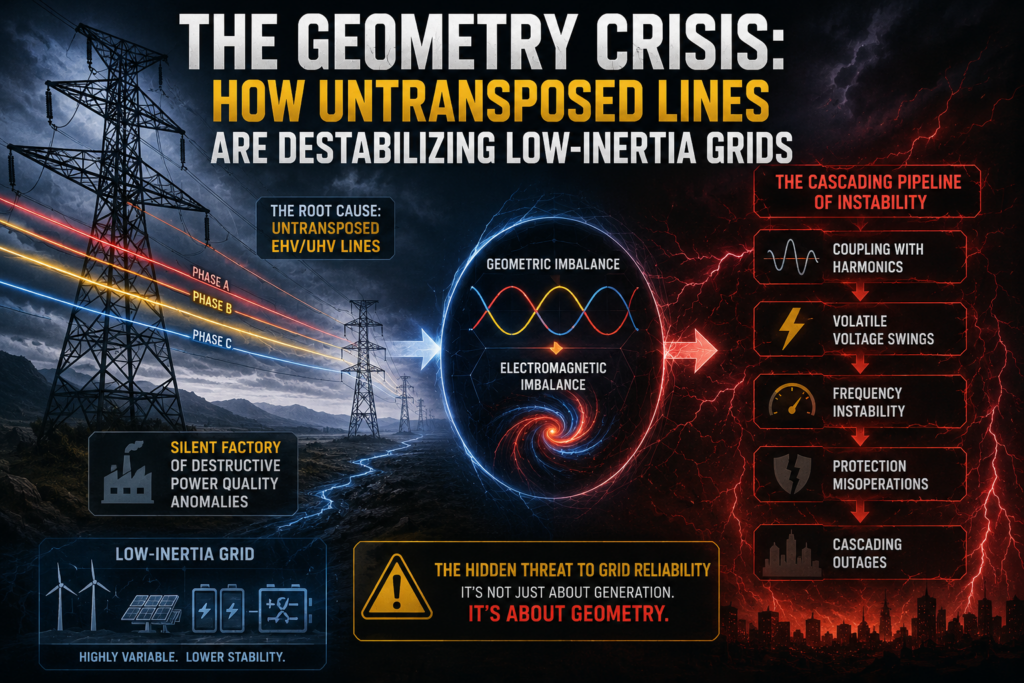
Long, untransposed Extra-High Voltage (EHV) and Ultra-High Voltage (UHV) transmission lines are acting as massive, silent factories spinning destructive power quality anomalies into our networks. This structural imbalance triggers a catastrophic cascading pipeline that couples with harmonics, drives volatile voltage swings, and shatters frequency stability.
The harsh reality of modern energy systems is clear: The crisis isn’t just about how much power we make, but how contaminated it becomes during transit.
Part 1: The Cascading Core — A Destructive Feedback Loop
To understand how grid geometry can bring down regional infrastructure, we must map out the intersections where electrical physics meets modern network architecture. In legacy grids heavily cushioned by bulk synchronous generation (coal, gas, and nuclear), minor power quality anomalies were absorbed by massive electromechanical inertia. In today’s low-inertia grids—highly populated by Inverter-Based Resources (IBRs) like wind and solar—these phenomena do not operate in isolation. They feed into one another, creating a destructive feedback loop.
1. Negative Phase Sequencing (NPS) and Harmonics
In a pristine, theoretically balanced three-phase system, current and voltage waveforms are shifted exactly 120 degrees apart, rotating in a “positive” sequence (A → B → C). However, when non-linear, single-phase, or unbalanced industrial loads pull current unevenly, they inject Harmonics (high-frequency distortions) into the grid.
Harmonics are mathematically classified by their phase sequence characteristics. Crucially, the 5th, 8th, 11th, and 14th harmonics are inherently Negative Sequence Harmonics. Because they possess an opposite phase sequence to the fundamental grid frequency, they generate magnetic fields that rotate in the reverse direction. Consequently, high Total Harmonic Distortion (THD) directly injects and exacerbates NPS profiles, forcing heavy machinery, motors, and utility generators to battle brutal counter-torque and severe localized overheating.
2. Negative Phase Sequencing (NPS) and Voltage Swings
Voltage unbalance (NPS) is directly coupled to systemic impedance variations and dynamic loading conditions. When a grid experiences sudden, macro-level Voltage Swings (transient dips, swells, or un-stabilized voltage excursions), the voltage unbalance ratio changes dynamically.
Conversely, severe NPS means that the three phases operate at asymmetric magnitudes. If one phase plunges while another swells, it triggers cascading protection responses. Furthermore, these voltage deviations alter the operating points of IBRs. As solar and wind inverters try to compensate for the unbalance, their control loops frequently inject volatile, unbalanced currents back into the network, further destabilizing the total voltage envelope.
3. Voltage Swings and Frequency Stability
The interaction between voltage and frequency is governed by basic active and reactive power dynamics ((P-f) and (Q-V) control loops). When severe voltage swings occur, power transmission capabilities alter instantaneously, as modeled by the power-transfer equation:
| P = | V1V2 | sin δ |
| X |
Where V1 and V2 are terminal voltages, X is line impedance, and δ is the power angle.
A sudden voltage dip drops the magnitude of active power (P) that can physically cross a transmission corridor. Because that electricity cannot move, an instantaneous power mismatch manifests between generation and load. In a low-inertia network missing traditional rotating electromechanical mass, this active power mismatch instantly triggers a high Rate of Change of Frequency (RoCoF). Frequency stability degrades in milliseconds, threatening a total domino-effect grid collapse.
4. The Grand Macro Feedback Loop
The vulnerabilities come together in a self-reinforcing circle of degradation:
If frequency drops, generators or inverters may mistime their solid-state switching or trip offline via protection relays. This sudden detachment changes the remaining network topology, shifts impedances, worsens harmonic resonance, amplifies phase asymmetry (NPS), drives massive voltage swings, and continuously bleeds corporate capital via premature asset failure and hardware degradation.
Part 2: The Critical Threat of Untransposed Transmission Lines
While end-use components and variable generation are often blamed for power quality issues, the primary physical driver of structural unbalance is the macro-infrastructure itself: Untransposed Transmission Lines.
What is Transposition?
In a three-phase overhead transmission line, the physical positioning of the conductors relative to each other and the earth dictates their electrical characteristics. Because conductors are spaced geometrically (e.g., flat horizontal configuration or vertical configuration), the physical distance between Phase A and Phase B is inherently different than between Phase A and Phase C.
This geometric asymmetry causes each phase conductor to have a slightly different self-inductance and mutual capacitance. Transposition is the engineering practice of physically swapping the conductor positions on the transmission towers at regular intervals. Over the entire length of a line, each phase occupies each physical position for an equal distance, balancing out the structural electrical characteristics.
Why Untransposed Lines Are Destructive
When a utility fails to transpose its lines, or intentionally builds long stretches without transposition to save on tower fabrication and engineering costs, it creates a permanent state of Unbalanced Impedance across the transmission network.
Even if the power leaving the power station is perfectly balanced, passing it through an untransposed corridor forces the currents to encounter asymmetric impedances. This fundamental unequal impedance generates Negative Phase Sequence (NPS) currents and voltages out of thin air, structurally contaminating the grid before the power ever reaches a city distribution network.
Part 3: The Scaling Laws — Why EHV and UHV Lines Magnify the Crisis
The reason untransposed lines evolve from a minor power quality nuisance into a catastrophic multi-regional event at the Extra-High Voltage (EHV, 230kV – 765kV) and Ultra-High Voltage (UHV, 800kV+) levels comes down to scaling physics:
-
Massive Power Quantities (I2X and V2B Effects)
EHV and UHV lines transmit thousands of megawatts over massive distances. Because transmission capacity scales with the square of the voltage, even a tiny 1% structural unbalance in line impedance translates to hundreds of megawatts of asymmetric power. This creates massive, unmanageable NPS currents that propagate straight through step-down substations and flow deep into local industrial zones and data centers.
-
Bundle Conductors and High Mutual Capacitance
To combat corona discharge and reduce power losses at EHV/UHV levels, utilities deploy “bundle conductors” (using multiple closely spaced sub-conductors per phase).
-
Exacerbation of Harmonic Propagation
Long, untransposed high-voltage corridors exhibit specific natural resonance frequencies. The structural impedance unbalance distorts the characteristic impedance of each individual phase. When high-frequency harmonics injected by downstream solid-state electronic devices travel up into an untransposed EHV corridor, the line can act as an amplifier for specific negative-sequence harmonics, converting a localized, low-voltage harmonic issue into a multi-regional power quality crisis.
-
Triggering Dynamic Voltage Swings and Frequency Cascades
Because untransposed lines introduce systemic voltage unbalance (NPS), the grid operates with dangerously narrow regulatory safety margins. If a transient fault occurs on a low-inertia network, the combination of existing structural unbalance from an untransposed UHV line and the dynamic fault shock causes severe, localized voltage swings.
Inverter protection schemes or legacy relays frequently mistake these asymmetric voltage swings for severe short circuits, causing massive renewable generation plants to instantly trip offline via localized protection mechanisms. This sudden, unexpected loss of generation collapses frequency stability, bringing down regional power grids.
Conclusion: The Path Forward
Ignoring the geometry of the transmission network is no longer an option for modern grid operators. As synchronous generation continues to step down and inverter-based resources step up, power networks lose their electromechanical buffers. Power contamination during transit must be addressed with the same urgency as generation capacity deficits.
To secure the grids of tomorrow, system operators and policy makers must look past broad average metrics. They must focus on the engineering realities of structural impedance balance, mandate rigid line transposition cycles, and recognize that grid resilience relies fundamentally on structural symmetry.
