
Best Practices, Power Quality Consulting, Power Quality Matters, Power Quality Monitoring
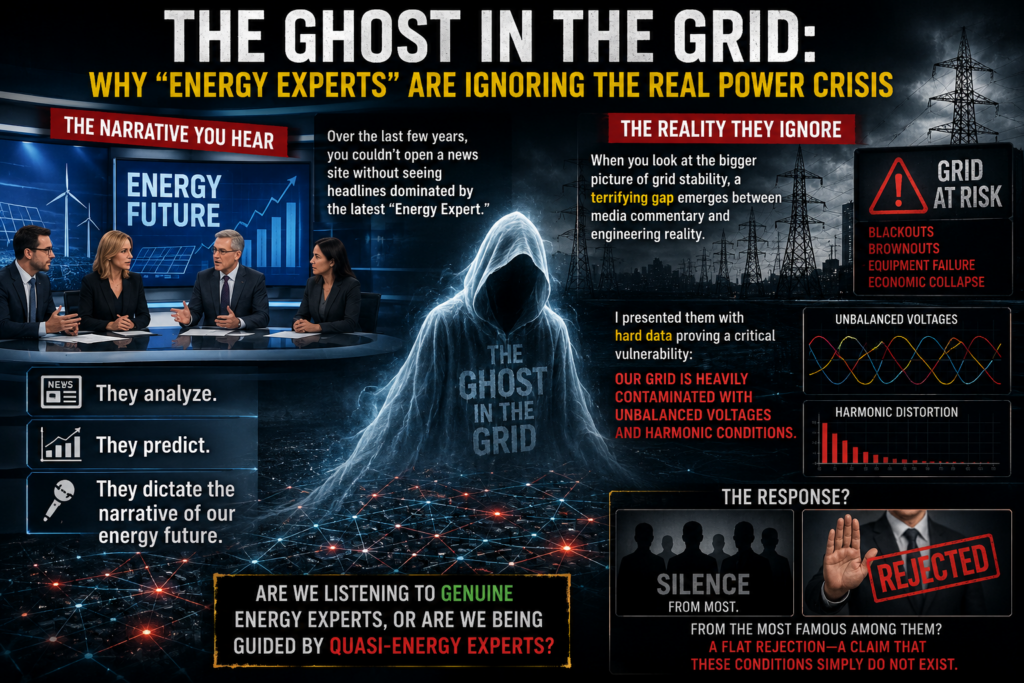
The Ghost in the Grid
Jun
Why “Energy Experts” Are Ignoring the Real Power Crisis
Over the last few years, you couldn’t open a news site without seeing headlines dominated by the latest “Energy Expert.” They analyze, they predict, and they dictate the narrative of our energy future.
But when you look at the bigger picture of grid stability, a terrifying gap emerges between media commentary and engineering reality.
A while ago, I reached out to several of these prominent figures. I presented them with hard data proving a critical vulnerability: our grid is heavily contaminated with unbalanced voltages and harmonic conditions. The response? Silence from most. From the most famous among them? A flat rejection—a claim that these conditions simply do not exist.
This begs a critical question: Are we listening to genuine Energy Experts, or are we being guided by Quasi-Energy Experts?
The Definition vs. The Reality
By definition, an Energy Expert is a professional in the energy sector with specialized knowledge in energy production, distribution, and consumption. They are meant to provide guidance, conduct comprehensive energy audits, and design solutions to improve energy efficiency, reduce costs, and ensure compliance.
If the industry and media trust them implicitly, we have to look back at our history with a critical eye:
- The Load-Shedding Blindspot: Why did these experts fail to sound the alarm on load-shedding before it crippled our economy? If they were conducting comprehensive audits and designing solutions, why didn’t the industry listen—or why weren’t they warned?
- The Power Quality Silence: For over two years, I have been sounding the alarm on a crisis of deteriorating Power Quality (PQ) and the failure of fundamental Grid Stabilization Engineering. Yet, this narrative receives zero support from mainstream “experts.”
Are they truly experts, or do they simply possess the media power, influence, and authority to drown out uncomfortable engineering truths? Or worse: Are they waiting for a catastrophic event—like the Iberian Grid Collapse—to finally look at the data?
The Silent Contamination: What’s Being Left Out of the Headlines
Right now, the media is buzzing with excitement over two major topics:
1. Bid Windows
These are specific periods where Independent Power Producers (IPPs) submit competitive bids to supply renewable energy under procurement programs like South Africa’s REIPPPP. Each window brings immense excitement surrounding new capacity targets for wind, solar, and battery storage.
2. Power Wheeling
The current media darling. Power wheeling is the transportation of electricity from a private generator to a remote end-user through an existing third-party transmission or distribution grid. Every week, a new wheeling agreement makes headlines. But here is the question no one is asking: Do these “Energy Experts” know what rapid, uncoordinated power wheeling is doing to the physical grid? If they know, why are they silent? If they don’t know, they shouldn’t bear the title of expert.
While the public conversation is entirely obsessed with the Energy Availability Factor (EAF) and adding raw megawatts, an engineering threat is quietly destroying localized distribution layers, burning out sensitive automation arrays, and compromising structural safety.
Aside from the brilliant investigative work of journalist Kathryn Porter, virtually no one is reporting on this crisis. As I previously published in The Silent Grid Contamination, the root cause isn’t just how much power we make—it is deeply embedded in the physical geometry of the transmission lines carrying it.
The Anatomy of Grid Contamination
When high-voltage transmission lines traverse hundreds of kilometers, the physical conductors are strung on massive towers in specific arrangements (vertical, horizontal, or triangular). Because of this physical positioning, the distance between each phase conductor and the earth—as well as the spacing between the conductors themselves—is unequal.
Without periodic physical rotation (transposition), these unbalanced line geometries act as giant, silent factories of Negative Phase Sequencing (NPS).
In a balanced system, alternating current waveforms rotate harmoniously in a positive sequence (A → B → C). NPS introduces a destructive, opposing electrical vector spinning in the exact reverse direction (A → C → B). This triggers a devastating power quality cascade:
- The Harmonic Pipeline: Non-linear loads inject integer harmonics (the 5th, 8th, 11th, and 14th) into the network, which inherently feed and amplify existing grid NPS vectors.
- Thermal Aggression: Because NPS vectors rotate backward, they generate massive electromagnetic counter-torque inside rotating machinery, causing extreme localized heating and insulation breakdown in transformers and generators.
- Protective Tipping Point: Modern protection relays frequently mistake these sharp asymmetric voltage swings for severe faults, causing generation plants to instantly trip offline and risking multi-regional blackouts.
As synchronous thermal generation is systematically phased down, the grid loses its natural electromechanical buffer to absorb this geometric asymmetry. Yet, our “Energy Experts” remain silent on the physics of transit.
The Decommissioning Disaster and the Ego Problem
Recently, the media splashed headlines celebrating the decommissioning of yet another coal-fired power station, earmarked to be replaced by a solar PV plant.
But replacing a massive spinning thermal mass (coal) with intermittent, inverter-based generation (solar) creates a severe stabilization deficit. Why is no one talking about repurposing the infrastructure?
Human ego and bureaucratic silos often prevent elegant engineering solutions. Will the unbundled entities like the National Transmission Company of South Africa (NTCSA) take over these sites and repurpose them? Probably not. And true to form, the mainstream “Energy Experts” haven’t uttered a word about it—despite “designing solutions” being in their very job description.
In our upcoming article, “Rebirth of Modern Power” (publishing 16 June 2026), we map out the exact engineering blueprint to solve this: converting closing plants into Synchronous Condensers (SCs).
The Asset Metamorphosis: A Step-by-Step Execution
Step 1: Decommission the Power Plant
The thermal generation unit is officially taken offline from active fuel injection. Fireboxes are extinguished, and boiler assemblies are brought down to cold conditions while leaving high-voltage grid connections, core instrumentation, step-up transformers, and busbars intact.
Step 2: Remove Steam / Gas Turbine
The mechanical coupling linking the massive steam or gas turbine to the electrical generator rotor is split. The prime mover components are physically extracted or disconnected, completely removing fuel reliance and eliminating maintenance overhead associated with thermodynamic cycles.
Step 3: Add Flywheel
To substitute for the missing rotational inertia of the decoupled turbine stages, a high-density mass—such as a specialized 10-ton flywheel asset—is permanently balanced and mounted directly to the rotating shaft. This structural addition guarantees the massive electromechanical anchor has the physical inertia required to damp out grid-frequency drops (RoCoF).
Step 4: Add Pony Motor
Because synchronous condensers do not produce their own mechanical drive power, a dedicated fractional startup drive—a pony motor—is attached. This configuration starts the entire unit from a standstill, bringing the heavy unpowered shaft assembly smoothly up to synchronous electrical speed. Once matched, the generator safely synchronizes with the utility grid, and the pony motor cleanly uncouples via an integrated mechanical clutch assembly.
Why Repurposing is the Ultimate Grid Savior:
- Immediate System Strength & Voltage Stiffness: Reborn synchronous condensers possess massive, physical rotating mass. This physical inertia limits the immediate Rate of Change of Frequency (RoCoF) during disruptions, buying the automated control loops of renewable plants time to respond without tripping offline.
- Damping Unbalance and Swings: Because these machines behave as solid voltage source anchors, they dramatically increase localized short-circuit capacity. Their natural physics allow them to natively counteract voltage unbalance, absorb transient shocks, and suppress volatile voltage swings caused by untransposed transmission lines.
- Bypassing Supply Chain Bottlenecks: Grids across the globe are scrambling for purpose-built synchronous condensers, resulting in skyrocketing costs and massive manufacturing order backlogs. Rebirthing an old asset utilizes existing infrastructure—the massive generators, heavy-duty step-up transformers, switchgear, and high-capacity grid connections are already perfectly in place.
“Converting a single large, existing thermal generator (e.g., a 750 MVA unit) can completely obviate the need to construct five or more smaller, purpose-built synchronous condensers from scratch. It slashes implementation timelines down to a fraction of the time, saving hundreds of millions in capital expenditure.”
The Clock is Ticking
A good friend of mine—someone I consider a true engineering energy expert—recently confided in me with a chilling reality check: We do not have much time left to act.
Fact is, we may have already missed the window of opportunity to guarantee we will not experience a catastrophic blackout. The lead time required to plan, engineer, and commission a repurposed power station into a synchronous condenser is now longer than the time-window we have left before disaster hits us.
It is time to look past the media-friendly soundbites, look past the hype of bid windows, and demand that the people steering our energy policy address the invisible crisis of Power Quality. If our current “experts” won’t talk about grid physics, we need to find experts who will.
