
Jul
Why South Africa’s Grid Enforcement is Failing Your Business
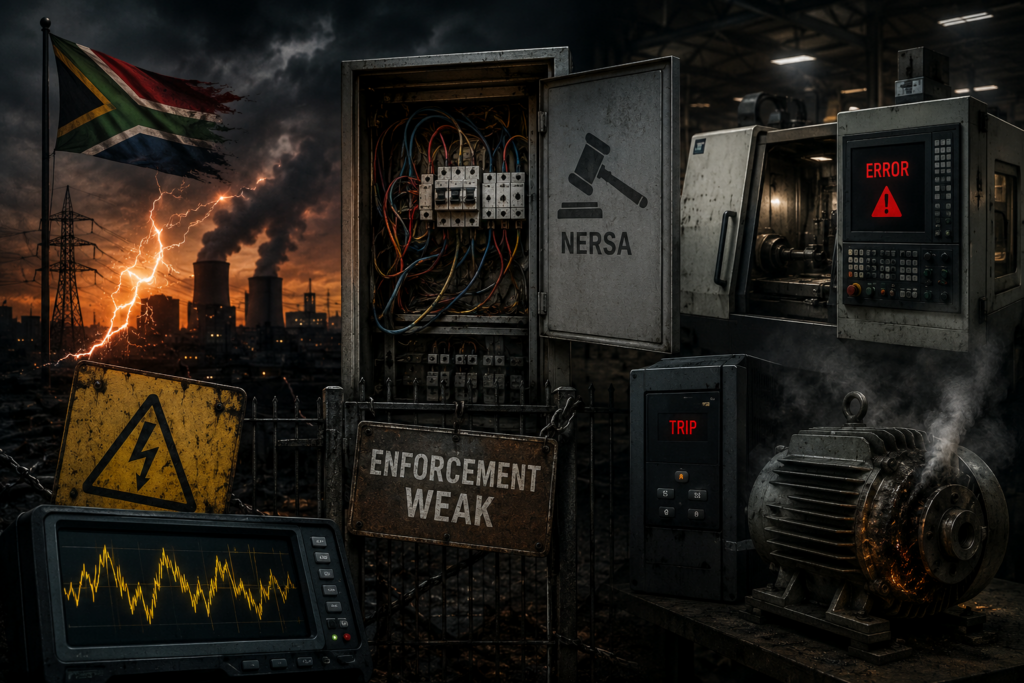
For those of us running businesses in South Africa, the frustration is visceral. You’ve finally secured power, but your expensive CNC machines are glitching, your VSDs are tripping for no reason, and your high-efficiency motors are burning out years before their time.
We call it “dirty power,” but the truth is simpler: our grid is a Wild West of technical non-compliance. While the UK’s Great Britain (GB) system remains a benchmark for stability, our local industry struggles because NERSA’s enforcement often lacks the granular teeth needed to protect our equipment. The latest June 2024 updates from the UK’s National Grid Electricity System Operator (ESO) reveal a clear blueprint for what we are missing. By comparing their rigorous Guidance Notes to our current regulatory gaps, we can see why “having power” isn’t the same as having quality power.
The Five-Year “Restatement”: Why Compliance Isn’t Forever
In South Africa, we suffer from a dangerous “set and forget” mentality. Once a developer gets their initial permit from NERSA, there is almost no follow-up to ensure the plant hasn’t drifted out of spec.
The GB model, under the recent GC-0141 modification, treats compliance as a living commitment through a “Compliance Repeat Plan.” To maintain their Final Operational Notification (FON), users must restate their compliance every five years. This isn’t just a tick-box exercise; it requires a signed User Self Certification and a full disclosure of any changes to the original Planning Code data. If a plant fails to prove it is still a “good citizen” of the grid, the ESO doesn’t hesitate to downgrade them.
“In the case where requirements are not fulfilled and the user is deemed non-compliant, ESO will issue them a LON [Limited Operational Notification], and the relevant process will be followed. It may be that some restriction is imposed, until the user resolves the issues.”
Breaking the IP Deadlock: How the GB Register Protects OEMs and Speeds Up Connections
A major pain point for SA developers is the standoff between NERSA and Original Equipment Manufacturers (OEMs). Regulators want the “secret sauce” (sensitive technical data) to model grid impact, but OEMs are terrified of losing their intellectual property. This stalemate delays projects for months.
The GB system bypasses this through the “Manufacturer’s Data & Performance Report.” OEMs submit their proprietary dynamic models directly to the ESO’s “generic register.” This protects the manufacturer’s IP while giving the operator everything they need to verify capability. A developer simply references a standardized code in their application. This transparency accelerates connection timelines—something our market desperately needs.
Double-Entry Monitoring: The “Back-up” Rule
Accountability in the GB system is built on a “trust but verify” redundancy that would surprise many SA operators. During compliance testing, the ESO doesn’t just rely on its own meters. The grid code requires the station to provide its own digital monitoring equipment to record signals in parallel.
For a consultant, the engineering precision here is key: the signals must be provided as dc voltages within a specific range of -10V to +10V, with the station ensuring a high input impedance (around 1MΩ) so the loading effect on the signal source is negligible. This “double-entry” rule ensures that a single instrument failure doesn’t invalidate a million-rand commissioning test.
The Four Basic Signals for Mandatory Monitoring
| Signal | Units | Signal Representation |
|---|---|---|
| Total Active Power | MW | 0 to 8V = 0 to Reg. Capacity |
| Total Reactive Power | MVAr | -8V to +8V = -Reg. Capacity to +Reg. Capacity |
| Line-Line Voltage | kV (HV) | 0 to 8V = Nom. Voltage ±10% |
| System Frequency | Hz | -8V to 8V = 48.0Hz to 52.0Hz |
Precision PQ: The Engineering Recommendations G5/4 and P28
While NERSA’s enforcement of power quality often feels vague or reactive, the GB model uses site-specific “Bilateral Agreements” to set iron-clad limits. They rely on two heavy-duty standards: G5/4 for harmonics and P28 for voltage flicker.
When a new plant includes “non-linear” elements (like solar inverters or wind turbines), the Transmission Owner performs a rigorous “Stage 3” assessment. Crucially, they don’t just guess; they calculate contributions based on the international IEC61400-21 standard. Developers are forced to disclose every detail of their reactive compensation design, including specifically tuned components to prevent resonance.
“The Electromagnetic Compatibility Levels for harmonic distortion on the Transmission System from all non-linear sources… shall comply with the compatibility levels given in Appendix A of Engineering Recommendation G5/4.”
The “Interim” Reality: Capacity Restrictions as a Shield
In the rush to solve our energy crisis, South Africa often allows plants to rush to full-capacity commissioning. The GB model takes a safer, “graduated” approach using the Interim Operational Notification (ION).
Think of the ION as a “probationary” phase. The ESO can legally impose capacity restrictions on a new plant, preventing it from exporting its full output until it proves it can handle voltage and frequency response tests. This restriction acts as a shield for the rest of the grid’s users. It is only after the operator is satisfied with the plant’s performance under these restricted conditions that the capacity is fully released. It’s a disciplined sequence that prioritizes grid health over raw megawatts.
Conclusion: A Question for the South African Industry
The stability of the GB grid isn’t magic—it’s the result of a structured, transparent “Guidance Note” approach that treats the grid as a shared asset. By moving away from our “set and forget” culture and adopting a five-year repeat compliance cycle, we could finally stop the “dirty power” that is bleeding our small businesses dry.
The question for us is: Is the South African industry ready for the level of transparency and engineering accountability seen in the GB model, or will we continue to let our equipment pay the price for a loosely enforced grid?
