
Best Practices, Power Quality Consulting, Power Quality Monitoring
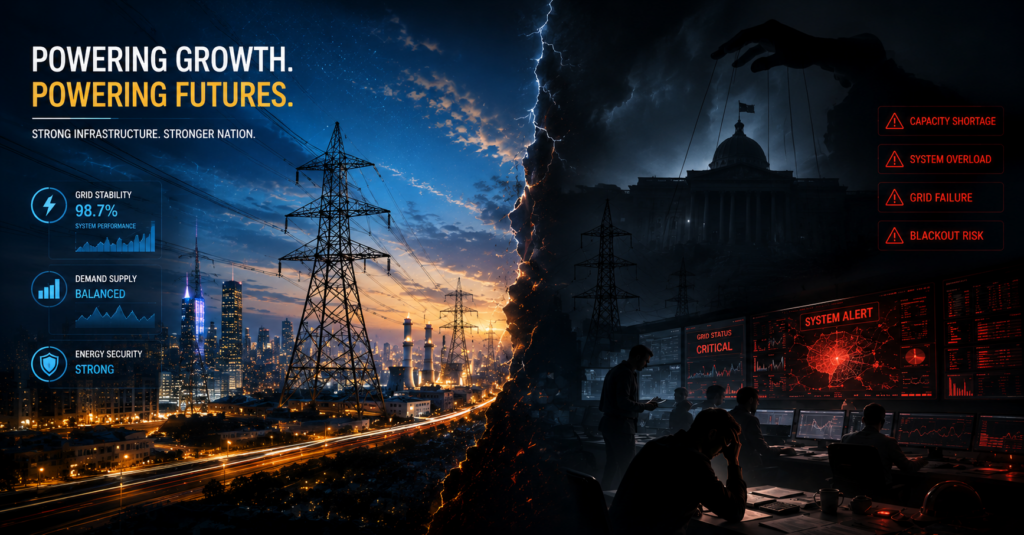
When Politics Weakens the Grid
Jul
When Politics Weakens the Grid, the Lights Go Out
South Africa’s load-shedding crisis is not just an energy problem — it is a governance problem, a skills problem, and a leadership problem.
Across the world, major blackouts tend to follow the same pattern: political interference weakens institutions, investment is delayed, technical capacity erodes, and the grid becomes too fragile to absorb shocks.
Political interference
Tariff suppression, unstable leadership, and delayed investment weaken the utility and reduce resilience.
Technical capacity
Power systems depend on experienced engineers and technicians to manage protection, restoration, and maintenance.
Economic damage
Outages disrupt production, raise operating costs, and reduce investor confidence across the economy.
System warning
Load-shedding is often the managed version of a deeper infrastructure failure.
When politics enters the power grid
Across many countries, electricity-sector problems begin with political interference. Governments may suppress tariffs, delay capital investment, or appoint leaders for loyalty rather than competence.
Over time, this weakens the utility’s ability to maintain plants, expand capacity, and respond to emergencies.
In South Africa, the electricity crisis has been tied to corruption, poor governance, and instability at Eskom. The result has not been one single disaster, but a long period of recurring load-shedding that has damaged growth and investor confidence.
Why technical skills matter
Power systems depend on highly trained engineers and technicians. These are the people who manage protection systems, diagnose faults, coordinate restoration, and keep the grid stable under stress.
When utilities lose experienced staff, the system becomes harder to run safely. Maintenance slows down, planning weakens, and small problems can turn into large ones.
What the blackout cases show
The 2019 blackout across Argentina, Paraguay, and Uruguay showed how a fault in one part of an interconnected system can spread rapidly when governance and maintenance are weak.
Millions were left without power, and the event exposed how vulnerable regional grids become when investment is delayed and operational coordination is poor.
The 2025 Chile blackout revealed another side of the problem. A transmission-line failure spread widely enough to affect Santiago, the metro, emergency services, and major copper mines.
That outage showed that even a single technical failure can become a nationwide crisis if resilience is too low.
The 2025 Iberian Peninsula blackout was even more dramatic. In seconds, a huge amount of generation was lost, and Spain and Portugal were plunged into darkness.
Why South Africa is part of the same story
South Africa’s load-shedding crisis is the chronic version of this global problem. Instead of one dramatic blackout, the country has experienced repeated controlled outages because the system cannot always meet demand safely.
Load-shedding is a way of preventing a total collapse when generation is too weak, plants are unreliable, or maintenance has been neglected. This is why the crisis is so important: it shows what happens when political interference, underinvestment, and skills shortages persist for years.
The economic cost
Factories stop.
Transport slows.
Shops lose sales.
Households pay more for backup power.
In mining economies like Chile, the cost is especially severe because power interruptions immediately disrupt production and exports. In Spain and Portugal, the losses were measured in billions of euros. In South Africa, repeated load-shedding has acted like a tax on the entire economy.
What needs to change
The solution is not simply “more electricity.” It is better governance, stronger institutions, and a skilled workforce.
That means protecting utilities from political interference, appointing leaders on merit, investing consistently in maintenance and transmission, training and retaining engineers and technicians, building redundancy into the grid, and creating regulatory systems that reward reliability.
South Africa is already moving in some of these directions, including transmission expansion and market reform. But the real test is whether reform is sustained long enough to restore confidence and technical resilience.
South Africa does not need to accept chronic instability as normal. The path forward requires depoliticising the power sector, strengthening technical capability, and treating electricity reliability as a national competitiveness issue.
