
Best Practices, Consulting Services, Power Quality Consulting, Power Quality Matters, Power Quality Monitoring
The Weightless Grid
Sep
Why Silicon Alone Can’t Replace the “Spinning Steel” of Our Power History
For over a century, the absolute bedrock of grid reliability was “spinning steel.” Massive, multi-ton metal rotors in coal, gas, and hydro plants served as physical shock absorbers for the system. Their rotational kinetic energy provided an instantaneous, physics-driven response to fluctuations, naturally stabilizing frequency before a single sensor could even register a change. Today, as we retire these thermal giants, we are pivoting toward a “Weightless Grid” dominated by solar panels, wind turbines, and batteries. This new grid is a high-speed digital phantom attempting to mimic the heavy-duty physics of the industrial age. While this transition is non-negotiable for the climate, we are discovering that silicon transistors—switching electricity thousands of times per second—cannot easily replicate the inherent stability of massive moving parts.
Takeaway 1: The “Identity Crisis” of the Inverter (GFL vs. GFM)
The primary challenge in a weightless grid is the shift from “pilots” to “passengers.” Most existing renewable installations utilize Grid-Following (GFL) inverters. These are passive passengers; they use a Phase-Locked Loop (PLL) to “listen” to the grid’s rhythm and inject current in lockstep. However, under weak grid conditions—specifically where the Short Circuit Ratio (SCR) drops below 2.0—the coupling between the PLL and the grid impedance triggers severe voltage oscillations. If the grid reference vanishes, GFL inverters simply shut down.
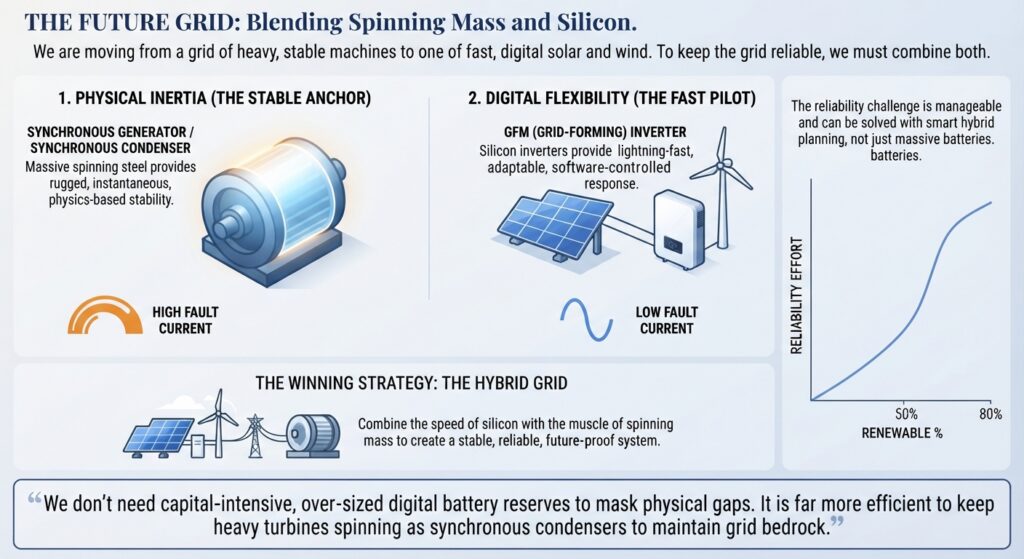
In contrast, Grid-Forming (GFM) technology represents the shift from passenger to pilot. These inverters act as controlled voltage sources, internally establishing their own frequency and voltage references.
The ability of GFM-equipped Battery Energy Storage Systems (BESS) to “create” the grid—providing Black-Start Capability—is the vital cornerstone of a zero-carbon future. We have already seen this move from theory to reality on the island of Bonaire. There, a 6 MW Wärtsilä BESS governed by GEMS software manages extreme wind fluctuations and automates grid restoration, proving that silicon can indeed take the lead when the spinning steel stops.
Takeaway 2: The “Fault Current Gap” – Silicon’s Delicate Nature
Despite the sophistication of GFM technology, we face a fundamental thermal reality: silicon is too delicate for the “street fights” of electrical faults.
The Achilles’ Heel of Digital Inertia
When lightning strikes a line or a short circuit occurs, the grid requires a massive, instantaneous surge of “fault current” to maintain system integrity. Traditional synchronous machines are rugged; their electromagnetic-mechanical coupling allows them to output 3.0 to 5.0 times their rated current (and up to 10 times in thermal plants) to clear a fault.
Silicon-based inverters, however, are thermally limited. Subjecting them to such spikes causes the semiconductors to overheat and fail instantly. Consequently, they are capped at a meager 1.1 to 1.2 times their rated current. This creates the “blind relay” problem. Relays are the grid’s smoke detectors—if they cannot see the “smoke” of high fault current, they cannot trigger the “fire alarm” to trip the breakers. This necessitates a complete, and incredibly expensive, redesign of protection coordination across the entire global energy infrastructure.
Furthermore, digital switching introduces “Control Loop Latency.” If these feedback loops are too slow, the inverter can exhibit “Negative Resistance” characteristics, triggering harmonic resonances that destabilize the very network they are meant to support.
Takeaway 3: The Exponential Math of Renewable Reliability
A common strategic error is assuming that grid stability challenges grow linearly with renewable adoption. In reality, “stochastic noise”—the unpredictable, second-by-second randomness of weather—creates an exponential penalty for reliability.
Data from the IEEE 39-bus test system reveals that the required virtual inertial support scales non-linearly as we strip away traditional generation:
- 10% Renewable Penetration: 24.3% probability of frequency violations; requires 3,472 MW-s of support.
- 30% Renewable Penetration: Requires 5,664 MW-s of support.
- 50% Renewable Penetration: Requires 9,734 MW-s of support.
- 70% Renewable Penetration: 84.7% probability of frequency violations; requires 14,107 MW-s of support.
As we approach high penetration, the effort required to manage stochastic noise doesn’t just double; it explodes. This noise cannot be “deleted”; it can only be dampened at a progressively steeper economic and capacity penalty.
Takeaway 4: The Multi-Day Wind Drought Penalty
While solar energy presents a predictable diurnal cycle, wind power introduces a “sizing penalty” that separates Power (MW) from Energy (MWh). Solar variability can be balanced with 4-to-8-hour batteries, but stochastic wind variability is characterized by multi-day droughts.
To guarantee 100% reliability during a three-day wind drought, the required volume of battery storage (MWh) balloons to cost-prohibitive levels. We are no longer just buying a “fast” battery to balance frequency; we are forced to buy a “massive” battery to bridge a weather anomaly. For many grid operators, this makes a 100% battery-only approach a capital efficiency nightmare.
Conclusion: The Hybrid Horizon
The verdict is clear: GFM inverters are operationally essential, but they are not a magic wand. They provide the lightning-fast “Silicon speed” needed for modern response, but they lack the “muscle” to handle the raw physics of faults and long-duration droughts.
The future of the grid is not a choice between batteries and the past, but a hybrid horizon. We must pair advanced electronics with Synchronous Condensers (SynCons)—rotating machines that provide physical inertia and high fault current without burning fuel. By retrofitting retired thermal plants with SynCons, we maintain the “spinning steel” bedrock while the silicon spine handles the digital choreography of renewables.
