
Best Practices, Power Quality Consulting, Power Quality Monitoring
Where Did My 600 Units Go
Jun
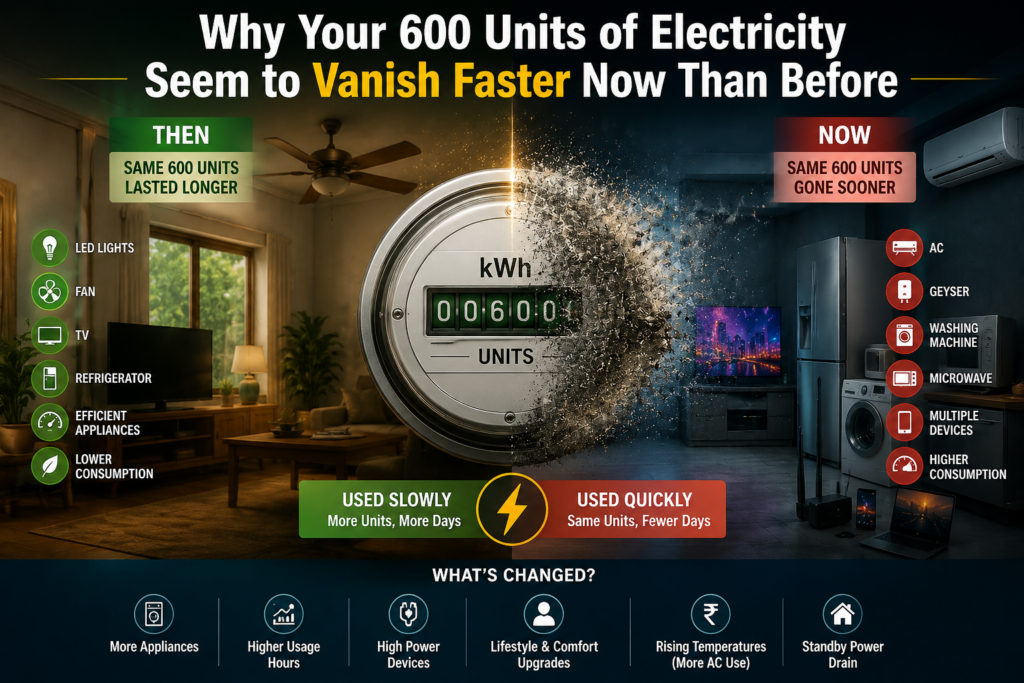
Why Your 600 Units of Electricity Seem to Vanish Faster Now Than Before
Have you ever looked at your electricity statement or prepaid meter voucher and felt a nagging sense of confusion? You buy the exact same 600 units of electricity that you always have, but it feels like your home burns through them much faster now than it did a while back.
No, your utility provider isn’t cutting corners, and your mind isn’t playing tricks on you. The answer lies in how your household appliances interact with electricity, an evolving efficiency balance in your home, and an engineering concept called The Electrical Power Triangle.
The Baseline: How Meters Are Calibrated
To understand what is shifting in your home, we must first look at how electricity meters are engineered. When an electricity meter is built and calibrated, the process is performed using a pure, known resistance value (such as a precision heating element).
In a purely resistive environment, 100% of the electrical energy delivered is converted directly into useful work (like pure heat or light). In engineering metrics, this means that the calibration baseline ratio of Real Power (P) in kWh to Apparent Power (S) in kVAh is a perfect 1 : 1.
If your home only ran on pure, unadulterated resistance, your 600 units would always last the exact same amount of time. However, modern homes are filled with a complex mix of electronics and magnetic devices that break away from this ideal ratio.
Understanding the Electrical Power Triangle
To visualize where your purchased energy goes, electrical engineers use a structural geometric diagram called the Electrical Power Triangle. It contains three sides:
- Real Power (P) – [kW / kWh] (The Horizontal Base): The true working power that carries out actual tasks, such as turning a motor, running a computer, or heating water.
- Reactive Power (Q) – [kVAR / kVARh] (The Vertical Side): Non-working power. Magnetic appliances—such as refrigerator compressors, air conditioners, pool pumps, and modern LED transformer circuits—require this power to sustain the magnetic fields needed to run.
- Apparent Power (S) – [kVA / kVAh] (The Hypotenuse): The total, absolute power delivered by the utility network to your meter. It represents the combination of both Real and Reactive components.
Visualizing Your Fixed 600 Units
Watch how your 600-unit Apparent Power line stays the exact same length, but swinging upwards causes your useful Real Power to shrink!
• Ratio: 1.04 : 1
• Actual Useful Energy: 576.9 kWh
• Wasted Reactive Overhead: ~164.7 kVARh
The Math: Testing Three Home Energy Scenarios
When you buy 600 units, your meter logs that total capacity as Apparent Power (kVAh). Let’s dive into how the three mathematical ratios affect how much working power (kWh) your household actually extracts from that pool.
Scenario 1: High-Efficiency Baseline (Ratio 1.04 : 1)
In a home with highly modern, clean circuits, the ratio sits tight at 1.04 : 1 (a Power Factor of approximately 0.96). Calculating the actual useful energy:
The Result: Out of your 600 purchased units, 576.9 units convert into real work. Your appliances operate perfectly, minimizing overhead losses.
Scenario 2: Average Household Degradation (Ratio 2.37 : 1)
If you have added multiple electronic devices, older refrigeration units, or unoptimized inverter setups over time, the ratio drops significantly to 2.37 : 1 (a Power Factor of roughly 0.42).
The Result: You receive only 253.2 units of working energy! More than half of what you bought is transformed into reactive energy to keep magnetic fields energized. Your 600 units run out twice as fast because your usable pool has split.
Scenario 3: Severe System Inefficiency (Ratio 3.37 : 1)
In highly unoptimized homes—running aging air conditioning compressors, uncalibrated water pumps, or budget power adapters—the system hits a critical ratio of 3.37 : 1.
The Result: A minor 178.0 units actually accomplish any useful task. Over 70% of your voucher value is spent handling non-working overhead, making it seem like your electricity is evaporating instantly.
Summary Matrix: Where Did the Energy Go?
| Scenario Ratio | Total Purchased (kVAh) | Useful Energy (kWh) | Reactive Overhead (kVARh) | System Efficiency |
|---|---|---|---|---|
| 1 : 1 (Calibration Baseline) | 600 | 600.0 | 0.0 | Perfect (100%) |
| 1.04 : 1 (High Efficiency) | 600 | 576.9 | 164.7 | Excellent (96%) |
| 2.37 : 1 (Moderate Degradation) | 600 | 253.2 | 544.1 | Poor (42%) |
| 3.37 : 1 (Severe Inefficiency) | 600 | 178.0 | 572.9 | Critical (30%) |
The Grid Factor: It Might Not Just Be Your Home
While it is easy to assume that aging appliances inside your house are entirely to blame for a ballooning Power Triangle, that is not always the case. Oftentimes, severe ratio degradation is caused directly by unbalanced network conditions on the utility company’s electrical grid.
In an ideal delivery system, the voltage supplied across the neighborhood distribution grid lines is perfectly symmetric. However, if your utility provider experiences unbalanced phase loading, degraded transformer banks, or loose neutral links on their poles, the voltage hitting your home arrives highly unbalanced.
When unbalanced voltage enters inductive household equipment (like your refrigerator, HVAC unit, or bore pump motors), it creates harmful negative-sequence currents. To combat this uneven magnetic force and continue spinning, your motors are forced to pull massive amounts of Reactive Power (Q) from the line. Through no fault of your own, the grid’s unbalance stretches your Power Triangle vertically, forcing your prepaid smart meter to register high kVAh usage and rapidly burning up your 600 units.
Conclusion: Turning Insight into Action
If your 600 units are moving considerably faster than they did “a while back”, your home’s Power Triangle has likely grown tall and unbalanced. Aging motors pull more inductive fields, modern smart prepayment meters monitor absolute apparent power overhead closer than old legacy wheels did, and unoptimized electronics drag your operational base down.
To remedy this, consider getting heavy items like HVAC systems and water pumps checked, or look into localized power factor correction solutions to help shift your triangle closer to that ideal, calibrated 1:1 balance!
