
Best Practices, Power Quality Consulting, Power Quality Matters, Power Quality Monitoring
The Low-Inertia Trap
Jun
Critical Systemic Risk Advisory
Executive Summary: The aggressive decarbonization timeline threatens structural electrical inertia. Replacing thermal baseload assets with non-synchronous, inverter-based variable renewable energy (VRE) introduces catastrophic vulnerabilities to Rate of Change of Frequency (RoCoF) transients, forcing a strategic re-evaluation of Net Zero operational targets.
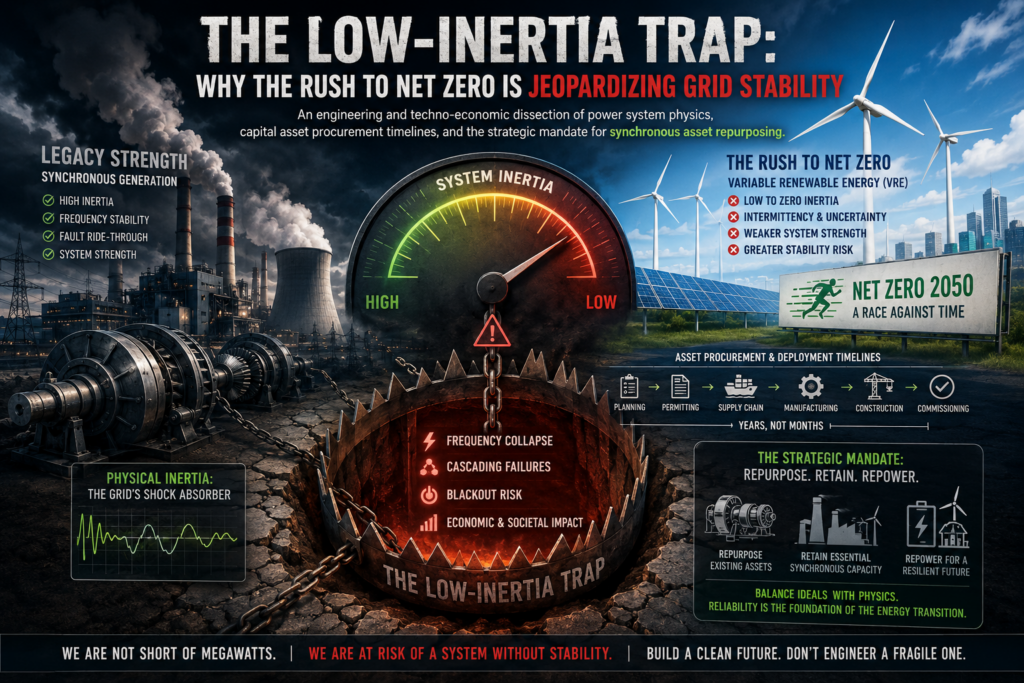
The Low-Inertia Trap: Why the Rush to Net Zero is Jeopardizing Grid Stability
An engineering and techno-economic dissection of power system physics, capital asset procurement timelines, and the strategic mandate for synchronous asset repurposing.
The global energy landscape is locked in a fierce paradigm conflict. On one side stands an aggressive, ideologically driven rush toward rapid decarbonization and a strict, legally binding “Net Zero 2050” timeline. On the other lies the rigid, unforgiving reality of power system physics. As power grids worldwide accelerate the decommissioning of aging coal and gas fleets to rapidly hook up variable renewable energy (VRE) sources like wind and solar, operators are quietly dismantling the fundamental bedrock of grid security: electrical inertia.
For high-level stakeholders, policymakers, and energy asset investors, this transition cannot simply be evaluated as swapping megawatt-hours for megawatt-hours. If we do not explicitly address the systemic vulnerabilities inherent to a low-inertia grid, we are not building a cleaner future—we are engineering a highly fragile macro-system prone to cascading, nationwide blackouts.
1 The Physics of Vulnerability: Anatomy of a RoCoF Surge
To comprehend the foundational risks of modern grid management, one must look directly to the mechanics of alternating current (AC) networks. Conventional coal, gas, and nuclear power stations utilize massive, heavy spinning generators. Because these multi-ton mechanical masses are physically, electromagnetically synchronous with the grid, their rotational kinetic energy acts as a natural, instantaneous buffer. When an unexpected generation deficit occurs—such as a major thermal unit tripping offline—the kinetic energy stored inside these spinning rotors is instantly, automatically injected into the network. This inherent synchronous inertia acts as a giant brake, slowing down the rate at which the system frequency drops.
In stark contrast, wind turbines and solar photovoltaic (PV) arrays generate electricity as direct current (DC) or at variable frequencies, which must be routed and converted to standard AC via power electronics (inverters). These systems possess zero physical inertia. They do not naturally resist rapid changes in the grid’s operating state. When a low-inertia grid experiences a severe generation-to-load mismatch, the system frequency ($f = 50text{ Hz}$ or $60text{ Hz}$) doesn’t just drift—it plunges at an unmitigated velocity. This is known mathematically as a Rate of Change of Frequency (RoCoF) Surge.
The Governing Differential Equation of Grid Transient Stability
The danger embedded in this math is absolute. As total system inertia (H) drops toward near-zero levels due to the aggressive retirement of spinning synchronous plant assets, the value of the derivative df/dt escalates exponentially. When a major asset trips in a low-inertia framework, frequency can breach critical operational safeguards within fractions of a single second—far faster than human operators or traditional mechanical turbine governors can react.
If frequency breaches the strict safety envelope, automated under-frequency protection relays trip instantly to protect their physical hardware from catastrophic mechanical destruction. This triggers a lightning-fast, cascading failure loop: dropping frequency forces remaining generators offline, accelerating the deficit, plunging the frequency further, and resulting in an uncontrollable macro-grid collapse.
2 The Illusion of the Digital Band-Aid: BESS vs. Physics
A common counter-argument presented by proponents of a rapid green transition is that utility-scale Battery Energy Storage Systems (BESS) can compensate for lost inertia via Fast Frequency Response (FFR) or advanced “virtual inertia” inverter configurations. While BESS is an exceptional asset for intra-day energy arbitrage, relying on it to stop an immediate, high-RoCoF grid collapse fundamentally miscalculates the physical timelines at play.
| Performance Metric | Synchronous Generation | Battery Systems (BESS) |
|---|---|---|
| Activation Latency | Instantaneous (0 ms) Governed intrinsically by physics |
Delayed (20ms – 100ms+) Phase detection & processing lag |
| Primary Mechanism | Kinetic energy release from directly coupled rotating mass | Electrochemical injection via digital switching inverters |
| Mitigation Domain | Limits the initial velocity of the frequency plunge (RoCoF) | Arrests the frequency nadir and facilitates stabilization |
The Real-World Warning: Look no further than an operational fault in the European grid. While heavy nuclear and hydro infrastructure provided the instantaneous physical stabilization to absorb a major grid contingency, the high penetration of inverter-interfaced renewables across the Iberian Peninsula left local networks too weak to damp the shock wave, causing localized grid tearing and multi-hour blackouts. Digital algorithms simply cannot bypass the millisecond physical constraints of system mechanics.
3 The Socio-Economic Realities and the Net Zero Repudiation
As these technical cracks widen into massive system vulnerabilities, the international political consensus around unmitigated climate timelines is shifting from compliant acceptance to open skepticism. Globally, major political coalitions and parliamentary blocs are systematically repudiating or rolling back Net Zero 2050 targets.
Pragmatic state planners are arriving at the stark realization that sacrificing domestic energy sovereignty on the altar of climate ideology is a profound failure of governance. Forcing aggressive, artificial decarbonization pathways that provoke chronic grid instability destroys economic output, industry, and human well-being today, in an attempt to alleviate modeled environmental variables decades in the future.
Simultaneously, the rhetoric claiming that rapid green energy deployment will effortlessly generate a massive net surplus of industrial employment is being unmasked as a macroeconomic misconception. Completely dismantling legacy coal- and gas-fired generation complexes—rather than modernizing them—annihilates deeply concentrated local labor networks, destroying economic ecosystems in multi-generational industrial hubs and aggravating structural unemployment.
4 Timeline Realism: Infrastructure Procurement vs. Retrofitting
Engineering a highly resilient power architecture requires total timeline realism. Grid operators do not possess the luxury of infinite time; they must match system stabilization tools with the realistic velocities of asset deployment, planning, procurement, and construction lifecycles.
| Asset Strategy | Procure & Build Lifecycle Focus | Macro Duration | Grid Inertia Value |
|---|---|---|---|
| Thermal Repurposing (Synchronous Condenser) |
Isolating turbine components from boilers, engineering clutch systems, upgrading automatic voltage regulators (AVR), and hot-recommissioning mechanical generators. | 18 to 36 Months | Immediate / Critical |
| Wind & Solar VRE | Environmental assessments, land zoning, global inverter/panel procurement bottlenecks, long-distance transmission corridor build-out, and substation integration. | 3 to 6 Years | Zero Inertia |
| New Build Nuclear (Gigawatt / SMR Fleets) |
Seismic site selection, complex safety licensing, international vendor selection, specialized high-pressure forging fabrication, heavy civil engineering, and hot testing. | 10 to 15+ Years | Ultimate Baseload Anchor |
This structural matrix highlights a massive architectural gap. While constructing a completely new nuclear fleet offers the definitive, ultra-stable long-term anchor for a modern industrial economy, its immense deployment timeline makes it incapable of plugging the structural stability deficit over the immediate ten-year horizon. Conversely, rushing out localized wind and solar arrays can be executed with relatively low lead times, but doing so without synchronous backups actively degrades the transient stability profile of the network.
The logical, optimal solution lies in the rapid engineering modification of retiring thermal assets: converting obsolete coal and gas turbine alternators into synchronous condensers (capacitors). By mechanically decoupling the heavy generator rotor from the steam boiler system and keeping it synchronized using minimal imported power, these facilities continue providing vital physical inertia and high reactive power (VAr) support. Because the grid transmission connections and heavy civil foundations are already built and paid for, this strategy bypasses a decade of permitting and procurement gridlock while maintaining highly specialized engineering roles.
5 Is Wind Energy Truly Cleaner Than Nuclear Energy?
To formulate an honest macro-energy policy, we must cast aside localized operational emissions narratives and rigorously assess the comprehensive, full lifecycle cradle-to-grave impacts of our generation assets. Is the desperate rush to cover thousands of square kilometers in VRE wind systems genuinely cleaner than deploying baseline nuclear infrastructure? The fundamental raw material footprint exposes a different story.
Energy Density & Material Intensity Structural Comparison
Wind generation networks suffer from profoundly low energy density. To harvest equivalent annual energy outputs from an 800-megawatt thermal or nuclear facility, an operator must coordinate hundreds of wind turbines scattered over vast territories, requiring up to 200 times more structural wiring, concrete bases, and active transmission links. This resource requirement places unparalleled, destructive strain on global mineral supply chains and localized ecologies abroad.
For example, utility-scale offshore wind deployment consumes roughly 15 tons of refined copper for every single megawatt of capacity. Mining copper at these massive exponential volumes in key developing mining sectors liberates immense quantities of toxic arsenic and sulfur dioxide, poisoning local subterranean water aquifers and agricultural communities. Furthermore, the specialized rare-earth permanent magnets vital to modern high-efficiency turbine drivetrains are overwhelmingly processed in jurisdictions utilizing highly compromised environmental standards, leaving behind millions of metric tons of highly toxic, acidic refining sludge.
The Geopolitical Matrix: South Africa’s Energy Council & BRICS Dynamics
To navigate this structural transition, South Africa specifically formalised its Energy Council. This high-level body was mandated to bridge the deep chasm between public sector regulatory paralysis and private sector capital deployment. Recognizing that Eskom’s generation crisis threatened total industrial collapse, the Energy Council serves to forge a single, unified national strategy to accelerate new capacity investment, modernize grid infrastructure, and unblock the structural and legal bottlenecks delaying alternative generation assets.
However, the rapid nature of this institutional alignment raises critical questions among analytical observers. Could there be underlying strategic or ulterior motives for the Energy Council’s swift establishment, particularly at a time when overwhelming public support for an accelerated move towards Net Zero 2050 targets is visibly absent? As Western financial institutions increasingly tie development capital and loans to aggressive, immediate decarbonization conditions—effectively prohibiting the financing of grid-stabilizing thermal or nuclear infrastructure—South Africa has strategically leaned toward its BRICS partnerships for utility-scale relief.
China, dominating over 80% of the global solar supply chain in solar and wind generation products, has provided emergency generation equipment, and microgrid architecture to assist the South African economy during the height of load-shedding. May this be the reason for establishment of the Energy Council, a payback for the support. This shifting alliance underscores a deeper global reality: while there appears pushback against the unmitigated rush to Net Zero, South Africa is going in the opposite direction without concrete proof and, perhaps, having little concern about the grid stability while the solar and wind generation may be the cause of grid instability, and infrastructure support that allows developing nations to manage real-world, localized grid-stability challenges without economic collapse.
The Strategic Prerequisite for Energy Sovereignty
Carbon mitigation remains an admirable macro-objective, but the transition must be driven by strict engineering principles, free market mechanisms, and rigid system physics. Forcing variable renewable generation onto aging, low-inertia grids while aggressively dismantling the spinning thermal baseload core is a recipe for system destabilization.
Immediate Regulatory Mandates:
- ✓ 1. Establish Dedicated Inertia Markets Formalize regulatory and market mechanisms that explicitly price, value, and compensate grid-stabilizing providers of real, physical synchronous inertia.
- ✓ 2. Enact Mandatory Asset Conversions Institute immediate moratoria on the outright mechanical demolition of retiring thermal assets, funding their rapid conversion into synchronous condensers to protect the 10-year transition window.
- ✓ 3. Procure High-Inertia Baseload Assets Balance the variable clean energy mix by accelerating long-range capital procurement loops for next-generation, high-inertia nuclear power plants to permanently anchor the macro-grid.
