
Best Practices, Power Quality Consulting, Power Quality Matters, Power Quality Monitoring
Why the 60-Minute Hour is Breaking the Power Grid
Sep
5 Surprising Truths About Electricity Pricing
Exploring how legacy financial settlement windows distort modern grid physics and renewable economics.
1. Introduction: The High Cost of a Slow Clock
The physical reality of the power grid operates in milliseconds, but the financial systems governing it have traditionally moved at a snail’s pace. For decades, electricity markets have relied on the “slow” 60-minute financial hour to determine the System Marginal Price (SMP). This creates a dangerous friction: while electrons move at the speed of light to balance supply and demand, the “hourly” mindset masks the volatile reality of the modern grid.
As we transition toward a decarbonized world, this one-hour window is no longer a mere administrative convenience—it is a market distortion. Global energy markets are now shifting toward sub-hourly pricing, moving from 60 minutes down to 30, 15, or even 5-minute intervals. This evolution isn’t just about technical precision; it is a fundamental restructuring of how energy is valued. By aligning financial rewards with the high-speed requirements of grid physics, these new time-slices are rewriting the rules for renewables, batteries, and the bills on our desks.
2. The “Baseload Windfall” – How a 5-Minute Crisis Charges You for an Hour
In a traditional unbundled market, the most expensive generator required to meet demand—the “marginal unit”—sets the price for every other participant on the grid during that interval. This “uniform marginal pricing” model works well in theory but creates massive inefficiencies when the settlement window is too wide.
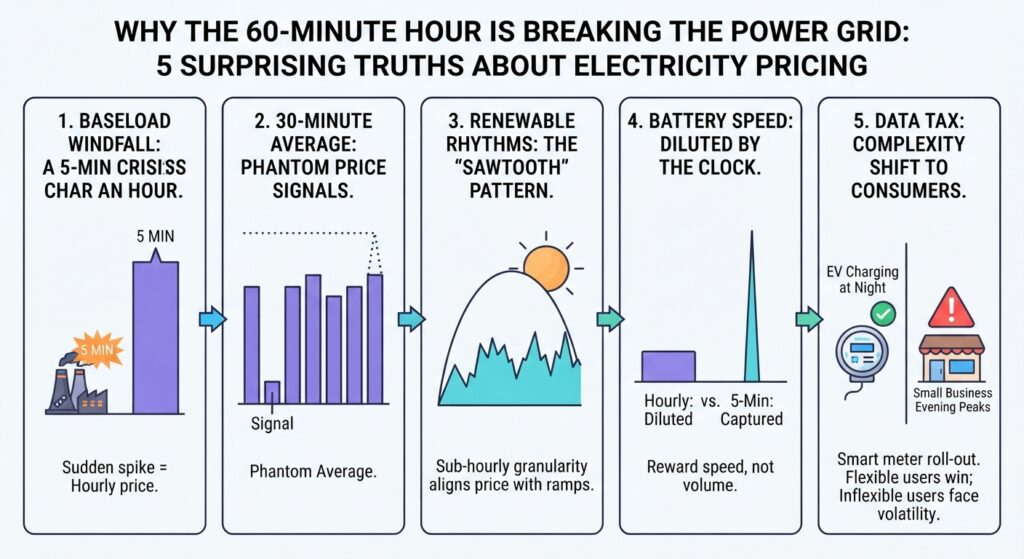
Take South Africa’s emerging wholesale market as a case study. When a coal unit trips or a solar ramp occurs unexpectedly, the System Operator may be forced to run an Open-cycle gas turbine (OCGT). These diesel-powered units are quick to start but extraordinarily expensive. If the OCGT runs for just five minutes to stabilize the frequency, under an hourly model, it sets a “sky-high SMP” for the full 60-minute block. Consequently, the entire low-cost baseload fleet is paid that emergency diesel rate for the full hour, even though the crisis was resolved in minutes.
Strategic analysis reveals this isn’t just a generation problem; it’s a curtailment trap. Currently, the System Operator (NTCSA) pays “Constrained Sales” compensation to Independent Power Producers (IPPs) when transmission bottlenecks limit their output. Because these payments are locked into 60-minute blocks, the operator often overpays for 10-minute bottlenecks as if they lasted an hour. Sub-hourly pricing “caps” this volatility by confining the price spike strictly to the interval when the expensive unit—or the constraint—actually exists.
“Eskom’s low-cost coal fleet currently benefits from these ‘massive financial windfall’ at the expense of distributors and consumers… This prevents short-term supply crunches from artificially inflating wholesale prices across the entire hour.”
3. The “30-Minute Average” Trap – Why Accuracy Can Actually Crash the Market
One of the most profound lessons in market design comes from Australia’s National Electricity Market (NEM). Before 2021, Australia operated under a mismatch: physical dispatch occurred every 5 minutes, but financial settlement was calculated as the average of those six periods (a 30-minute block).
This mismatch created a “destabilizing incentive.” If a supply constraint triggered a massive price spike in the first 5 minutes of a half-hour, the 30-minute settlement average would remain high regardless of what happened next. This signaled other generators to flood the market with energy for the remaining 25 minutes to chase that high average price. The result was a physical collapse: the over-response would crash real-time dispatch prices to the market floor of -$1,000/MWh while the financial settlement remained artificially inflated.
The Anatomy of a Timing Mismatch:
- Cause: A supply constraint triggers a 5-minute price spike.
- Effect: The 30-minute financial average remains high, creating a “phantom” price signal.
- Result: Generators flood the grid, crashing physical dispatch prices to -$1,000/MWh and threatening grid stability.
“Shifting to unified 5-minute bidding and settlement aligns financial rewards directly with physical dispatch, eliminating these artificial price oscillations.”
4. The “Sawtooth” Pattern – Navigating the New Rhythm of Renewables
As markets in Europe transition to 15-minute intervals, analysts at Montel have identified the emergence of a “sawtooth” price pattern. This pattern is the market’s response to the rapid “ramping” of solar and wind assets.
Hourly blocks are a “blunt instrument” that fail to capture the steep solar ramps of early morning and late evening. In a 15-minute market, the “sawtooth” reflects intra-hour price spikes caused by fixed capacity allocations and the market’s attempt to correct itself in real-time. This granularity serves as a critical signal, incentivizing generators to shift their output to the exact minutes where the grid is under the most stress. In a high-renewables grid, profit is no longer found in volume alone, but in the ability to follow these rapid rhythmic shifts.
5. Batteries are Being “Diluted” by the Clock
The economic viability of a decarbonized grid depends on fast-acting assets like battery storage and demand-side response. However, the 60-minute hour acts as a “dilution” mechanism that actively discourages private investment.
A battery’s greatest value is its speed—its ability to discharge high-value energy during a critical 5-minute peak. Under hourly pricing, that high-value burst is mathematically smoothed and averaged out over 60 minutes, drastically reducing the battery’s earning potential. Strategic analysts argue that sub-hourly pricing is a non-negotiable prerequisite for the green transition. By rewarding “speed” over “volume,” granular pricing allows batteries to capture extreme short-duration peaks, finally making grid-scale storage a bankable investment rather than a subsidized experiment.
6. The “Data Tax” and the Shift of Risk to the Living Room
The move toward sub-hourly granularity is not a free lunch. It introduces significant administrative complexity and a fundamental shift in who bears the risk of price volatility.
The Data Overhead
Transitioning from 24 price points a day to 288 (in a 5-minute system) creates a massive “Data Tax.” Every interval must be recorded, validated, and billed, requiring a total overhaul of IT infrastructure.
The Complexity Cost
As seen in the UK’s Market-wide Half Hourly Settlement (MHHS) reform, moving to 30-minute settlement requires universal smart meter rollouts. For small businesses, this often means moving away from simple flat rates toward “bespoke contract negotiations” and higher standing charges.
Winners vs. Losers: This shift creates a divide between flexible and inflexible users. EV owners who can charge at 2:00 AM will see their costs plummet. Conversely, “inflexible” users—such as small manufacturers or hospitality venues that must operate during evening peaks—will be exposed to raw, volatile market pricing they cannot avoid.
7. Conclusion: Beyond the 60-Minute Mindset
The evolution of electricity markets marks the end of the unbundled monopoly and the rise of high-granularity competition. We are moving away from a world where we “blend” costs together and toward one where every five minutes has a unique value. Aligning financial rewards directly with physical dispatch is the only way to stabilize a grid that no longer relies on the steady hum of coal, but the variable breath of the wind and sun.
As these reforms take hold globally, from the UK to South Africa to Australia, the strategic implications for industry are clear. We are entering an era of radical price transparency. The question for any energy-intensive operation is no longer just how much power you use, but when you use it. In a world where the price of your primary input changes 288 times a day, can your current business model survive the new rhythm of the grid?
