
Consulting Services, Power Quality Consulting, Power Quality Matters, Power Quality Monitoring, Solar Electric Power
The Hidden Friction of Clean Energy
Sep
5 Surprising Ways Solar is Testing the Grid
1. Introduction: The Invisible Complexity of the Solar Revolution
The rapid global expansion of solar power is widely celebrated as a triumph of green energy and a critical step toward decarbonization. However, beneath the surface of this transition lies a hidden reality: our aging distribution networks are facing unprecedented physical strain.
While the sun provides an abundant source of free energy, converting that energy into a form compatible with the existing power grid is not a seamless process. It introduces subtle, counter-intuitive engineering challenges that remain invisible to the average consumer but present significant hurdles for utility providers. Integrating high concentrations of solar power requires more than just panels; it requires managing the complex physics of an electrical system designed for a different era.
2. The Chaos of the “Uncoordinated” Rooftop
Most residential solar installations are connected to the grid as “single-phase sources” at the low-voltage level. When these installations grow rapidly without central coordination, they create a logistical nightmare for utility providers.
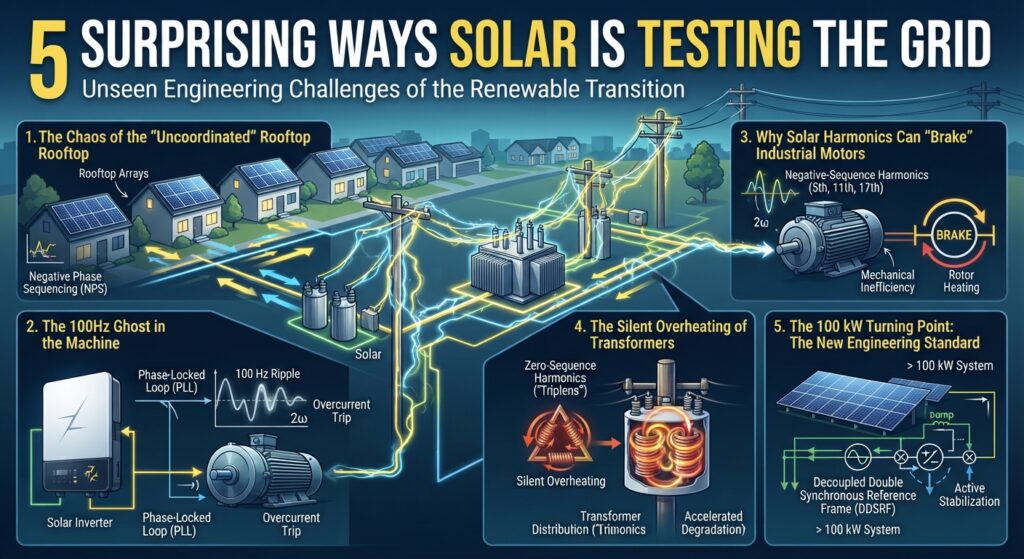
Because these rooftop arrays operate independently, their collective operation results in random, bidirectional power flows. This lack of coordination shifts the system’s neutral voltages and generates high-magnitude Negative Phase Sequencing (NPS). To understand NPS, imagine the grid as a precision machine rotating in one direction; NPS represents electrical components essentially trying to flow “backward” relative to that rotation. This creates a persistent state of voltage unbalance that compromises the stability and efficiency of the local network.
3. The 100Hz Ghost in the Machine
In “weak” distribution grids, unbalanced conditions introduce a phenomenon known as 2ω oscillations. In a standard 50 Hz system, this manifests as a 100 Hz ripple (or 120 Hz in a 60 Hz system).
These oscillations are particularly disruptive because they occur within the internal “synchronous reference frame” of the solar inverters. Specifically, they distort the Phase-Locked Loop (PLL) phase angle estimation—the very software mechanism the inverter uses to stay in “sync” with the grid’s frequency.
“These double-frequency oscillations… result in synchronization tracking errors and potential controller failure.”
This represents a surprising technical irony: the software meant to ensure solar energy flows smoothly into the grid can be “confused” by the grid’s own unbalance. If not managed, these 2ω oscillations propagate directly into the inverter’s DC-link capacitor. This generates significant voltage ripples and active power fluctuations, risking overcurrent trips and accelerated capacitor degradation—a high-cost failure point for any renewable system.
4. Why Solar Harmonics Can “Brake” Industrial Motors
One of the most counter-intuitive impacts of solar integration is how specific electrical “noise,” or harmonics, can physically interfere with industrial machinery. Through a process called Sequence-Network Harmonic Mapping, certain distortions created by inverters are injected into the grid in a reverse phase order (ACB).
The Harmonic Brake: Opposing the Momentum of Industrial Machinery
Negative-sequence harmonics—specifically those of the 5th, 11th, 17th, and 23rd orders—effectively rotate in the opposite direction of the grid’s standard flow. When these harmonics reach nearby industrial motors, they induce “counter-rotating braking torques.” This means the clean energy being fed into the grid is accidentally fighting against the physical rotation of industrial machinery, leading to severe rotor surface heating and mechanical inefficiency.
5. The Silent Overheating of Transformers
The complexity deepens when we consider Total Harmonic Distortion (THD). Solar inverters do not operate in a vacuum; instead, they interact with other single-phase non-linear loads, such as LED lighting and modern electronics. This combination leads to highly unbalanced levels of distortion across the three phases.
A specific category of this distortion, known as Zero-Sequence Harmonics or “Triplens” (3rd, 9th, and 15th orders), creates a different set of problems. These harmonics have zero phase displacement, meaning they are “in-phase” across the system. These currents are particularly dangerous for distribution transformers because of their “delta-connected” internal windings. The zero-sequence harmonics cannot leave these windings; instead, they circulate endlessly within them. The result is the silent, localized overheating of the transformer and excessive overloading of neutral conductors, significantly shortening the lifespan of critical grid infrastructure.
6. The 100 kW Turning Point: The New Engineering Standard
The physical risks of solar integration—from “braking” motors to burning out transformers—are precisely why regulatory bodies have established a firm line in the sand for larger installations. A critical engineering threshold has emerged: solar systems exceeding 100 kW are no longer allowed to be “passive” participants in the grid.
These larger systems are now required to be actively balanced across all three phases, with a maximum tolerance of only ±1 inverter string. To meet these demands, the industry is adopting the Decoupled Double Synchronous Reference Frame (DDSRF). Think of DDSRF as a high-speed digital filter and “mathematical brain” for the inverter. It allows the system to “see” the grid’s unbalance in real-time, estimating and eliminating 2ω oscillations. This enables the independent control of positive and negative-sequence currents, allowing the inverter to actively “damp” the unbalance on the grid rather than exacerbating it.
7. Conclusion: Beyond the Balanced Load
Integrating solar into our lives requires a fundamental shift in how we perceive electrical engineering. We can no longer rely on conventional “single-frequency” or “balanced loading” assumptions that served us for the last century.
As we move toward a decentralized energy future, the “intelligence” of the solar inverter becomes just as vital as the efficiency of the solar cell itself. The future of the grid depends on sophisticated power electronics that can manage the complex physics of an unbalanced system.
Are our current distribution grids ready for the complexity of a decentralized future, or is a total architectural overhaul the only way forward?
