
Power Quality Consulting, Power Quality Matters, Power Quality Monitoring
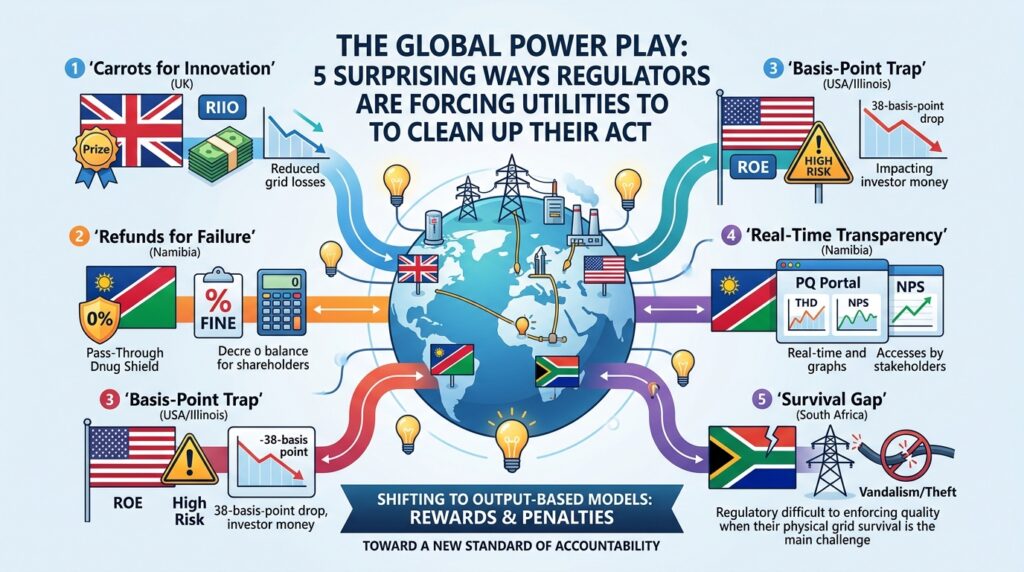
The Global Power Play
Sep
5 Surprising Ways Regulators Are Forcing Utilities to Clean Up Their Act
Electricity is often perceived by the public as a simple binary: it is either on or it is off. However, as any strategic analyst will tell you, the “on” is only half the story. Behind every flickering light and humming data center lies the hidden complexity of Power Quality (PQ). For modern infrastructure, it isn’t enough for power to simply be present; the voltage must be stable, the frequency consistent, and the current clean. While consumers take this stability for granted, electricity regulators globally are moving beyond simple oversight. They are employing increasingly creative—and occasionally brutal—mechanisms to force utilities to innovate. From the UK’s threat of fines totaling 10% of a licensee’s turnover for license breaches to aggressive financial “carrots,” the era of the passive utility is over.
The Innovation Prize: Why Ofgem Prefers Carrots to Sticks
In the United Kingdom, the regulator Ofgem has pioneered a shift from mechanistic penalties to a philosophy of “paying for performance.” Historically, distribution businesses were automatically fined if their energy losses—electricity that disappears during transit—exceeded a target. During one regulatory period (DPCR4), a single business lost an average of £8 million per year under this “fine-heavy” model.
Today, the UK operates under the RIIO framework, a system designed to ensure that utilities aren’t just paid for building hardware, but for delivering results that the public actually needs.
Instead of punishing measurement errors, Ofgem now manages a £32 million discretionary reward scheme. This is effectively a “prize” fund where companies compete for rewards by proving the qualitative success of their innovation projects. By shifting from the stick to the carrot, Ofgem encourages engineers to find creative ways to reduce losses rather than simply managing the risk of a fine.
Skin in the Game: Namibia’s “Performance or No Pay” Ultimate Refund
While the UK uses innovation prizes, the Electricity Control Board (ECB) of Namibia utilizes a much sharper financial deterrent: the Performance Management Framework (PMF). This model creates an environment with absolute accountability, linking a utility’s technical score directly to its bottom line.
Under this framework, licensees are assessed on specific Key Performance Indicators (KPIs). The consequences of failing to meet these standards are severe:
Key Metric: If a licensee scores below 50% on its performance assessment, it faces a 0% pass-through penalty.
In utility economics, a “pass-through” allows a company to recover unexpected costs from the customer. A 0% pass-through means the utility’s shareholders—not the customers—must eat every dollar of cost variance. It is the ultimate “skin in the game” model, forcing the utility to absorb the financial hit of its own technical inefficiency.
Hitting the Bottom Line: The 38-Basis-Point Equity Trap
In Illinois, USA, regulators have moved the target from the utility’s operational budget directly to the investors’ pockets. For utilities like Commonwealth Edison (ComEd), failing to meet reliability and safety targets results in a direct reduction of the Return on Equity (ROE).
Under formula-based rate plans, failing to achieve targets for outage duration and frequency can decrease a utility’s earned ROE by up to 38 basis points.
From a strategic perspective, this is a devastating blow. ROE is the primary magnet for infrastructure investment. A 38-basis-point reduction does more than just cut this year’s profit; it signals “high risk” to capital markets. This can raise the cost of future debt, making it significantly more expensive for the utility to borrow the money needed for future grid upgrades.
The Transparency Revolution: Real-Time Visibility via NamPower
Namibia has taken a surprising technological lead in the use of transparency as a regulatory tool. While the UK relies on annual “close-down” reports that summarize projects after they are finished, the Namibian regulator has embraced real-time access.
Through NamPower, the country launched a web-based Power Quality (PQ) portal. This system provides the regulator and transmission customers with “unlimited access” to download technical reports directly from monitoring points. This level of transparency covers critical parameters like:
- Total Harmonic Distortion (THD): Think of this as “electrical noise” or static. Too much THD can overheat industrial motors and damage sensitive electronics.
- Negative Phase Sequencing (NPS): This refers to imbalances in the three-phase power system that can cause industrial equipment to vibrate and fail prematurely.
By giving stakeholders direct access to this data, the regulator prevents utilities from “massaging” the numbers in annual reports, ensuring that technical degradation is visible as it happens.
The Survival Gap: When Vandalism Trumps Voltage Quality
The transition to high-tech, output-based regulation is a luxury of stable environments. South Africa’s regulator, NERSA, provides a sobering counter-point to the sophisticated models of the West. While NERSA monitors technical standards (like NRS 048-6), it often operates within a “regulatory enforcement gap” where technical perfection is sidelined by basic survival.
In South Africa, the challenge isn’t just fine-tuning harmonics; it is keeping the wires in the air.
“Electricity theft, illegal connections, and copper theft account for an estimated 40% of unplanned power outages in Eskom and municipal networks.”
The scale of this crisis is best illustrated by the data: in a study of the Soweto network, the SAIDI (System Average Interruption Duration Index, or the total time a customer is without power) reached 30.36 hours per year. This is more than double the regulator’s target of 14.61 hours. Similarly, the SAIFI (System Average Interruption Frequency Index, or how often the power goes out) reached 7.07 interruptions against a target of 6.
“It is absurd that physical destruction causes 40% of power outages, yet technical safeguards are repeatedly deprioritized just to keep the grid financially afloat.””
