
Best Practices, Consulting Services, Power Quality Consulting, Power Quality Matters, Power Quality Monitoring
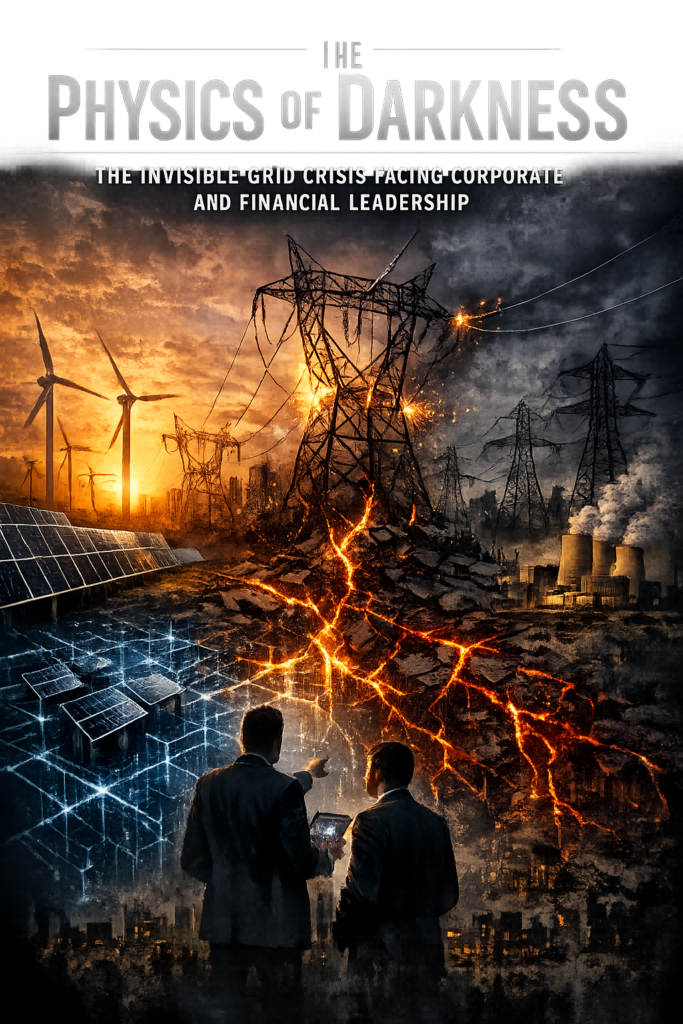
The Physics of Darkness
Jun
The Physics of Darkness
The Invisible Grid Crisis Facing Corporate and Financial Leadership
To the CEOs of major corporations, commercial banks, infrastructure funders, data center operators, and renewable energy developers: We need to talk about the physical reality of the power grids we rely on.
For years, collective attention has been laser-focused on the generation shortfall—the race to replace fossil fuels with clean energy. Across the globe, we celebrate the rapid, aggressive deployment of utility-scale wind and solar infrastructure. However, while adding renewable capacity solves the carbon and generation deficit, it introduces an entirely separate, invisible, and highly volatile challenge: the systemic erosion of power system stability.
“This challenge is acutely amplified in low-inertia and peninsular-type grids—regions like South Africa, South Australia, Great Britain, Italy, or parts of Southeast Asia—where geographic isolation or lack of strong, synchronous cross-border interconnections mean the grid must survive entirely on its own structural merit.”
As we decommission aging coal-fired fleets with massive spinning generators and aggressively connect inverter-based renewable energy sources (RES), we are fundamentally altering the nonlinear physics of transmission networks. If we continue to race toward renewables without institutionalizing grid-wide stabilization mandates, we aren’t just moving toward a cleaner future—we are racing toward a structural precipice.
01 The RoCoF Surge: The Terrifying Velocity of Kinetic Failure
Traditional power grids rely on massive, coal-fired spinning generators. These multi-ton rotating masses possess vast amounts of physical, rotational inertia. When a major generation plant trips or a massive load mismatch occurs, this structural inertia acts as a natural shock absorber, physically resisting sudden changes and slowing the rate at which the system frequency drops.
Inverter-based renewables (solar PV and wind) do not have these massive spinning masses; they interface with the grid via power electronics. As traditional synchronous plants are decommissioned, our physical shock absorber vanishes. When a severe generation-to-load mismatch occurs in a low-inertia grid, the system frequency plunges at an unmitigated velocity. This is known as a high Rate of Change of Frequency (RoCoF) surge.
The Battery Illusion
Many funders and network operators point to Battery Energy Storage Systems (BESS) as the ultimate backstop. But physics dictates a hard truth: while modern BESS systems can deploy Fast Frequency Response (FFR), standard Grid-Following (GFL) battery systems still require a finite period of roughly 60 to 120 milliseconds just to measure, process, and trigger active power injection.
- In a high-RoCoF event, the grid frequency can cross critical thresholds and reach point-of-no-return trip levels before standard digital storage sub-systems can physically react and inject counter-power.
- Without true grid stabilization mechanisms—such as Grid-Forming (GFM) inverters that provide simulated virtual inertia instantaneously without relying on phase-locked loops (PLL)—BESS alone cannot plug the foundational inertia deficit.
02 The Nightmare of Day Zero: The Long Road Back From Total Blackout
If a high-RoCoF event breaches the final lines of defense, the grid experiences a total blackout. Many business leaders mistakenly assume that once a blackout occurs, the grid can simply be switched back on over a weekend. The reality is profoundly different. Rebuilding an isolated, low-inertia power system from absolute zero—a Black-Start Restoration—is an incredibly delicate, high-risk engineering process that can take days or even weeks to execute safely.
Modern research demonstrates that under high renewable penetration, system restoration becomes exponentially more complex:
The Stability Penalty
Every step of a black start requires an orderly sequence: energizing transmission paths, stabilizing voltage, and incrementally picking up load. Load pick-ups naturally introduce power imbalances that cause immediate frequency declines. In a grid stripped of synchronous generators, there is insufficient baseline inertia to absorb these restoration shocks.
Secondary Collapses
If operators attempt to integrate highly variable, weather-dependent wind and solar generation during this hypersensitive restoration window, the recovering grid can instantly destabilize. A sudden fluctuation in renewable output can instantly trigger a secondary collapse, forcing operators to abort and restart the entire multi-day black-start protocol from scratch.
For a data center operator, a major commercial bank, or an industrial operation, a localized 2-hour blackout is an operational nuisance. A national grid collapse lasting 1 to 2 weeks means the total cessation of water pumping, fuel distribution, telecommunications, and banking services—an economic catastrophe of absolute proportions.
The Questions We Must Start Asking
This is not a message of doom; it is an urgent call for structural accountability. The institutions governing our energy landscapes must move past simple generation procurement and aggressively enforce dynamic grid stabilization. As corporate leaders, asset managers, and project funders whose capital and operations rely entirely on the structural integrity of the grid, we must start forcing hard questions onto the agendas of energy regulators and transmission network operators (TSOs):
1. What are the explicit grid-code requirements being established for utility-scale renewable plants regarding Grid-Forming (GFM) capabilities?
Are we mandating that new projects act as virtual synchronous machines to actively resist RoCoF surges, or are we continuing to fund vulnerable grid-following assets?
2. Are our regulatory frameworks and tariff structures incentivizing grid stabilization ancillary services?
Is there a clear monetization pathway for developers who deploy BESS with advanced grid-forming control structures, or are we exclusively paying for raw kilowatt-hours while ignoring the physics of power quality?
3. Why are very few grid operators publishing public, granular Total Harmonic Distortion (THD) datasets, and why do most treat power quality (PQ) data as operational information, sharing only aggregate compliance reports or annual summaries rather than raw harmonic measurements?
Without granular, non-aggregated harmonic distortion data, how can major data center operators, renewable funders, and high-tech industries truly measure, model, and mitigate local localized resonance risks caused by modern power electronics?
4. What does the national Black-Start Restoration plan look like in an era of a distributed, low-inertia grid?
Do our black-start units have sufficient coordinated energy storage support and rigid frequency constraints to prevent a catastrophic secondary collapse during network rebuilding?
The Bottom Line for Leaders
If you are funding a renewable project, your asset is only as viable as the grid it connects to. If you operate a data center, a bank, or a corporate empire, your operations are directly exposed to the physics of the transmission lines feeding your facilities.
Grid stabilization can no longer be treated as an esoteric engineering footnote. It is an existential macroeconomic priority. It is time to stop asking how much power we are generating, and start asking how stable that power actually is.
Let’s Future-Proof Your Infrastructure Together
As a consultant helping organizations navigate the energy transition, how can I best assist you in auditing your operational exposure to these specific transmission-level grid stability risks?
Book a Grid Risk Audit