Best Practices, Power Quality Consulting, Power Quality Matters, Power Quality Monitoring
Physics vs. Code
Jun
Physics vs. Code: The Invisible Battle to Keep the Grid from Crashing
As massive rotating machines vanish from our power networks, can clever software truly replace the immutable laws of physics?
As we move away from the massive coal-fired synchronous generators that have anchored the South African grid for decades, we are losing more than just carbon-heavy kilowatts. We are losing the “invisible heartbeat” of our electrical system: inertia.
The Vanishing Heartbeat of the Grid
In our local context, where the grid was designed around centralized rotating masses at plants like Medupi or Kusile, the transition to inverter-based renewables is stripping away the physical buffers that prevent a minor disturbance from becoming a catastrophic blackout. Inertia isn’t just a dry textbook term for engineers; it is the instantaneous kinetic energy that resists changes in frequency.
When a large load trips or a generator fails, it is this stored energy that keeps the lights on while slower control systems react. Without it, the Rate of Change of Frequency (RoCoF) becomes so steep that traditional protection systems cannot keep up, leading to cascading failures across our already strained national network. We are now entering a high-stakes competition to replace this lost stability between the “heavy iron” of traditional rotating machines and the “clever software” of power electronics.
The Heavyweight: Why You Can’t Argue with a Spinning Rotor
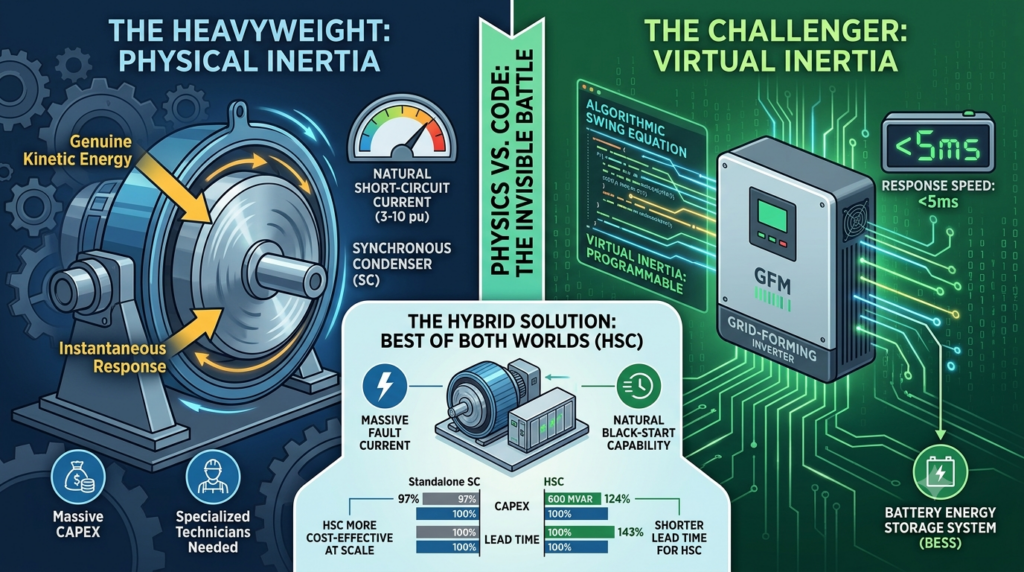
The Synchronous Condenser (SC) is the “old school” heavyweight of grid stability. Essentially a synchronous generator operating without a prime mover, it is a massive spinning rotor physically coupled to the grid frequency. Because this inertia is Newton-based, its response is instantaneous.
“Synchronous condensers… contribute genuine kinetic energy stored in their rotating masses. Because the rotor is physically coupled to the grid frequency, the inertial response is instantaneous and requires no measurement, communication, or control delay.”
For a grid operator, the SC is the “gold standard” for system strength, providing a naturally high short-circuit current (reaching between 3 to 10 per unit (pu)) vital for ensuring protection relays can clear faults. However, from a business perspective, the drawbacks include massive CAPEX, large footprints, and the operational headache of sourcing specialized technicians. Technically, they are also restricted to 0.5 pu of rated current when underexcited, meaning they struggle to manage voltage swells effectively.
The Challenger: When Software Mimics a Machine
The challenger is the Grid-Forming (GFM) Inverter. Unlike standard “grid-following” inverters that wait for the grid to tell them what to do, GFM inverters use an “algorithmic swing equation” to dictate voltage and frequency. They act as voltage sources that mimic the behavior of a physical machine through software.
The primary advantage is programmability—you can adjust the “virtual inertia” in real-time, a feat a physical rotor could never achieve. Furthermore, response speeds are blistering, with GFM converters starting their sub-transient response within 5ms, whereas traditional inverter systems often lag in the tens of milliseconds. However, software is energy-limited; to emulate inertia, the inverter must dispatch real power, which requires expensive Battery Energy Storage Systems (BESS).
| Technology | Response Speed | Mechanism |
|---|---|---|
| Physics-Based (SC) | Instantaneous | Zero control or measurement delay. |
| Algorithmic (GFM) | Within 5ms | Extremely fast, but limited by computation and control bandwidth. |
The Counter-Intuitive Risk: When “Synthetic” Inertia Goes Wrong
One might assume adding more virtual inertia is always better, but research from ABB and Universidad Carlos III de Madrid reveals a counter-intuitive danger. If the control signal for synthetic inertia is delayed, it can actually destabilize the grid.
Specifically, there is a “180-degree phase delay” threshold where, if the synthetic inertia signal lags by 180 degrees relative to the rotor swing, the electronic output operates in complete anti-phase to the machine. Instead of damping a disturbance, the software begins to fight the hardware, exciting sub-synchronous oscillations. As we increase emulated inertia, we require a “novel compensation mechanism” to damp these oscillations, proving that poorly tuned code is a liability rather than a silver bullet.
The “Magic Trick”: Inertia Without the Battery?
A potential game-changer for reducing cost comes from the University of Alberta’s 2019 US Patent. Their approach uses the DC-link capacitor—a standard component in a double-stage inverter—as the storage medium for inertia.
By mapping the changing voltage in the capacitor into an internal frequency, the system “tricks” the grid into seeing inertia without needing a massive, external BESS. For a business owner, this is the “holy grail” of GFM tech, as it potentially eliminates the secondary CAPEX of a battery while providing the programmable stability the grid desperately requires.
The Hybrid Solution: The Best of Both Worlds
Data from GE Vernova suggests the future isn’t a choice between iron and intelligence, but a Hybrid Synchronous Condenser (HSC) combining an SC with a GFM BESS.
- Massive Fault Current: The SC handles the raw violence of short-circuit faults (up to 10 pu).
- Fast Frequency Response: The BESS catches frequency drops (like a 2 Hz/s RoCoF event) faster than a machine can settle.
- Natural Black-Start Capability: Unlike a standalone SC, the BESS component allows the system to restart the grid after a total collapse—critical for the South African context.
The business case becomes clear as projects scale according to GE Vernova’s data:
- At 150 MVAR: A standalone SC is slightly cheaper (97% CAPEX of a Hybrid).
- At 600 MVAR: The tables turn, and a standalone SC solution’s CAPEX jumps to 124% compared to the Hybrid.
- Lead Time: In that same 600 MVAR scenario, the lead time for a standalone SC can be 143% of the Hybrid’s—a 43% longer wait is often a project-killer in our market.
