Best Practices, Physical Asset Management
The Collapse of South Africa’s Electricity Infrastructure
Jun
The Collapse of South Africa’s Electricity Infrastructure
A Comprehensive Analysis of Systemic Neglect, Financial Insolvency, and Catastrophic Risks across Eskom and Metropolitan Municipalities
1. Executive Summary & Core Premise
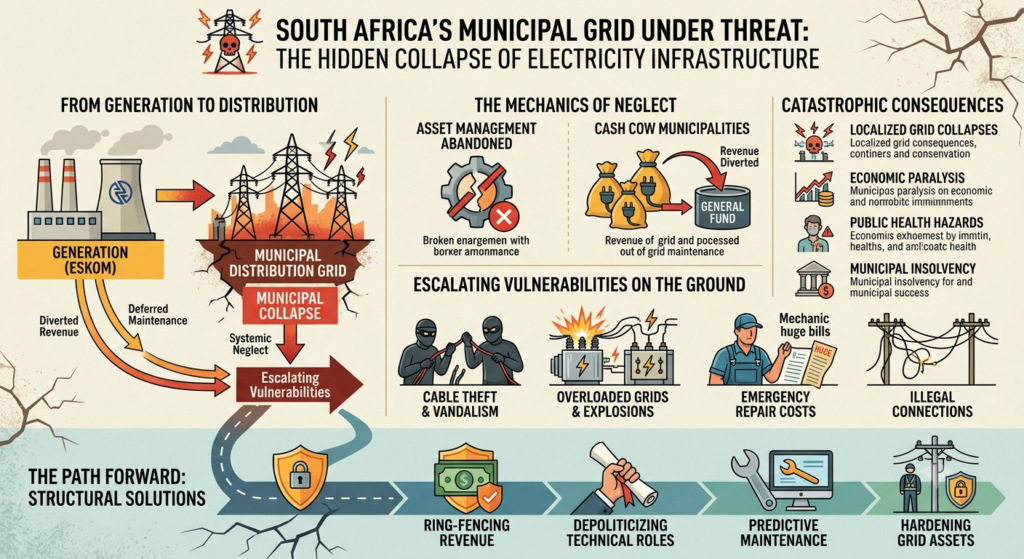
South Africa’s electricity supply industry is facing an existential threat that extends far beyond historical load-shedding. While generation capacity at the national utility, Eskom, has seen stabilization via improved maintenance regimes and private sector integration, the distribution layer—managed primarily by major metropolitan municipalities and local authorities—is undergoing a rapid, systemic collapse.
Decades of deferred maintenance, severe skills drain, rampant infrastructure theft, and financial malfeasance have degraded local networks. Furthermore, a circular debt crisis has emerged where metropolitan municipalities routinely collect revenue from end-users but fail to remit bulk payments to Eskom. This neglect is driving infrastructure toward a point of irreversible failure, threatening catastrophic consequences for public safety, industrial activity, municipal fiscal health, and national security.
2. The Mechanics of Neglect: Asset Management Failures
Sound asset management principles dictate that infrastructure must be stewarded to deliver a desired Level of Service (LoS) at the lowest Total Cost of Ownership (TCO) or life-cycle cost. In South Africa’s utility sector, these professional frameworks have been largely abandoned.
A. Deferred Maintenance & Life-Cycle Management
Physical assets such as medium-voltage (MV) and low-voltage (LV) cables, miniature substations, and large power transformers have finite operating lifespans. Without proactive, preventive, and predictive maintenance, equipment deteriorates rapidly. Municipalities have consistently prioritized operational expenditure (OPEX) on bloated administrative salaries or diverted electricity revenue to cover budget deficits in other departments (such as water or refuse). Capital expenditure (CAPEX) for equipment renewal is routinely underspent. Consequently, networks are operating well past their design lives, resulting in explosive failures, frequent cable faults, and widespread mini-substation burnouts.
B. Revenue Diversion vs. Revenue Collection Failure
Recent interventions by the National Ministry of Electricity and Energy highlight a deeply entrenched governance crisis. Entities such as Johannesburg’s City Power and the City of Tshwane carry billions of rand in outstanding bulk electricity debt to Eskom (with national municipal debt exceeding R110 billion). Detailed audits by civic organizations like OUTA confirm that end-use consumers are largely paying their bills; however, a catastrophic breakdown in revenue management means that funds collected for electricity are diverted to operational shortfalls elsewhere, leaving Eskom unpaid and local infrastructure starved of reinvestment capital.
3. Escalating Vulnerabilities: Theft, Vandalism, and Decay
The physical decay of infrastructure is accelerated by rampant criminality and a lack of security overlays.
- Copper Cable Theft & Vandalism: Syndicates target overhead lines, underground cables, and substation components. City Power alone estimates losses of R25 million per month due to cable theft and infrastructure vandalism, with annual repair bills exceeding R300 million.
- Substation Blowouts & Equipment Costs: Replacing a single transformer substation unit ranges between R690,000 and R1 million. When municipalities delay these replacements due to depleted budgets, neighborhoods are subjected to prolonged outages lasting days or weeks.
- Illegal Connections & Grid Overloading: Unmetered, illegal connections create massive, unbalanced loads on local distribution transformers. This causes miniature substations to explode or catch fire, destroying adjacent equipment and creating severe electrocution hazards in communities.
4. Catastrophic Consequences of Continued Neglect
Should this neglect and financial insolvency persist, South Africa faces a multi-tiered catastrophe:
A. Complete Localized Grid Collapses
Unlike generation, which can be centrally managed, distribution failures are localized. When cascading faults occur in a metropolitan area (e.g., due to oil leaks in aged transformers, failing switchgear, and lack of spares), networks can suffer total collapse. Repairing an entire network from the ground up takes months, leaving communities without basic services.
B. Economic and Industrial Paralysis
Industries, manufacturing plants, commercial hubs, and small businesses cannot operate without stable electricity. Persistent local outages destroy perishable goods, halt production lines, and deter local and foreign investment. Threats by Eskom to disconnect or throttle bulk supply to defaulting metros (such as Johannesburg and Emfuleni) serve as a stark reminder that entire economic hubs could be forcibly powered down due to municipal insolvency.
C. Public Health and Safety Hazards
Electricity infrastructure underpins water pumping, sewage treatment, and traffic management. Protracted power outages disable water reservoirs, causing raw sewage spills and a lack of potable water—a breeding ground for waterborne diseases. Furthermore, unmonitored live cables exposed by vandals present immediate, fatal hazards to the public, including children.
D. Municipal Insolvency and Fiscal Contagion
Electricity sales represent a significant portion (often over 25%) of total municipal revenue. Municipalities use the surplus from electricity markups to cross-subsidize other failing services. If municipal networks fail or if consumers abandon the grid for rooftop solar to escape unreliability, the municipal financial model collapses completely, resulting in widespread bankruptcies of local government bodies.
5. Conclusion & Recommendations
The neglect of South Africa’s electricity infrastructure by Eskom (historically) and metropolitan municipalities (currently) represents a ticking time bomb. Reversing this trajectory requires:
- Strict Ring-Fencing of Revenue: Electricity revenue collected by municipalities must be placed in dedicated, untouchable accounts used exclusively for bulk purchases, network maintenance, and capital renewal.
- Depoliticizing Technical Management: Critical technical, engineering, and financial positions must be staffed by certified, experienced professionals rather than political appointees.
- Aggressive Asset Management Implementation: Municipalities must adopt integrated asset management frameworks, tracking asset health, conducting predictive maintenance, and moving away from reactive “run-to-failure” models.
- Security and Hardening: Utilities must actively replace copper with non-lethal, lower-value materials (e.g., aluminum) and deploy advanced monitoring and private security to protect substations and distribution lines.
Without immediate, structural intervention, the localized collapse of municipal electricity distribution networks will trigger an irreversible socio-economic and humanitarian crisis across South Africa.
