Best Practices, Power Quality Matters
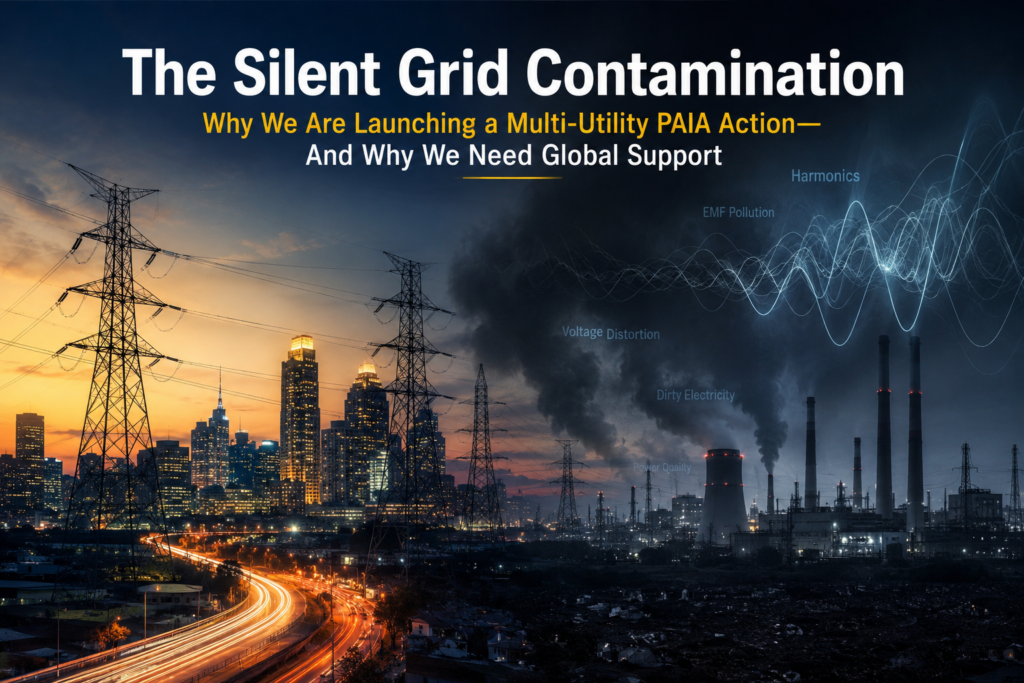
The Silent Grid Contamination
May
Why We Are Launching a Multi-Utility PAIA Action—And Why We Need Global Support
For decades, the global conversation surrounding South Africa’s energy landscape has focused on a single, visible crisis: capacity. We talked about load shedding, generation deficits, and grid-endangering debt.
But behind the headlines of balancing supply and demand lies a far more insidious, invisible crisis that is quietly destroying industrial equipment, inflating corporate electricity bills, and threatening the physical safety of human beings. It is the crisis of deteriorating Power Quality (PQ).
The Capacity Illusion: Generation EAF vs. Localized Power Quality
In macro-utility reporting, public accountability begins and ends with the Energy Availability Factor (EAF). EAF is strictly a quantity metric—it proves that a utility has successfully kept its boilers, turbines, and alternators running at the central generation source. However, once that electricity leaves the step-up transformers, it must travel through vulnerable transmission lines and pass through local municipal distribution networks.
This is where macro-availability completely decouples from localized technical reality. Even if a utility boasts an excellent EAF on paper, the localized power quality can be deeply contaminated. EAF measures the amount of water leaving the reservoir; it completely ignores the rust, contamination, and high-pressure bursts inside the local distribution pipes.
At Agulhas Utilities Corporation, we have been rigorously monitoring, analyzing, and sounding the alarm on this catastrophic degradation of network balance, phase-shift geometries, and harmonic profiles across South African networks. But when individual businesses or engineers raise formal complaints, a predictable, exhausting script unfolds: utilities perform rudimentary, average-quantity tests, declare that “everything is within standard operating limits,” and dismiss the issue.
The engineering data proves otherwise. The data does not lie. Because our state-run entities and metropolitan municipalities continue to operate in a vacuum of accountability, we are preparing to launch a sweeping legal action under the Promotion of Access to Information Act (PAIA). This action will legally compel the National Energy Regulator of South Africa (NERSA), Eskom, and all major metropolitan municipalities to hand over their internal records.
Strategic Transparency: Why We Are Signaling This Action Openly
A campaign of this magnitude naturally invites the question: Why broadcast our legal and operational strategy before the formal filing?
First, our positioning is backed by an extensive, immutable paper trail. We hold indisputable documentary proof of systemic network non-compliance, much of which has already been formally served to several of these primary state entities. We are not speculative; our baseline evidence is already locked in.
Second, our decision to target all major metropolitan municipalities—regardless of their size—is a deliberate structural necessity. If multi-tiered, heavily resourced metros are failing to manage basic grid code parameters, smaller and mid-sized municipalities are in a significantly worse position. Due to severe institutional constraints, these smaller metros lack the regulatory status, capital allocation, and technical engineering talent required to diagnose or mitigate complex network anomalies.
🌍 The Global Precedent: The 2025 Iberian Grid Collapse
If anyone doubts the catastrophic potential of unmanaged grid parameters, they need only look at the unprecedented blackout that crippled Spain and Portugal on 28 April 2025. Triggered by poorly damped, low-frequency “inter-area oscillations” and severe phase misalignment where the Spanish subsystem lagged by over 90 degrees, the vital 400 kV France–Spain interconnector tripped.
The resulting “total zero” system failure instantly dropped 15 GW of load, blacking out nearly the entire Iberian Peninsula, shutting down transport networks, and spilling over to cut power across parts of Southern France. It was the most severe European grid incident in 20 years, proving that when system operators lose grip on phase stability and wave oscillations, the entire system collapses in seconds—regardless of how much generation capacity is online. South Africa’s metros are currently drifting toward this exact cliff edge.
By standardizing this action across all metros simultaneously, we prevent utilities from hiding behind localized administrative excuses. To take this fight to the highest level, we are calling on the global community—multinational corporations, international data centers, legal firms, and funding institutions—to join us and provide the financial and strategic backing needed to force systemic accountability.
Technical Reality: What the Utilities are Hiding
Our specialized diagnostics across major networks have exposed an alarming reality. Traditional utility monitoring is fundamentally blind to the modern, high-frequency disturbances tearing through the grid. They measure average quantities over extended intervals, completely missing the destructive, asymmetrical waves that manifest in three distinct categories:
1. The Financial Chasm of Unbalanced Power Networks
In an ideal three-phase system, voltage magnitudes are equal and displaced by exactly 120°. Today, South African municipal feeders are showing severe negative-sequence and zero-sequence voltage components due to single-phase commercial and residential loads being distributed unevenly across phases.
When a network becomes unbalanced, it splits into what engineers call Symmetrical Components. Specifically, Negative Phase Sequences (NPS) act like a physical brake on industrial electric motors. An NPS voltage creates a reverse-rotating magnetic space harmonic field that fights against the motor’s intended forward rotation. Your machinery literally has to pull massive amounts of excess current just to overcome the counter-torque feeding it.
🔒 The Obfuscation of “Acceptable Unbalance” Standards
International engineering frameworks (such as EN 50160 and IEEE standards) dictate strict statutory boundaries for voltage unbalance, generally mandating that the negative-sequence voltage component must be kept under 1% to 2% for 95% of a weekly measurement period to protect electrical infrastructure.
In South Africa, however, these critical “acceptable unbalance” percentages are treated like state secrets. Metropolitan municipalities deliberately fail to publicize their operational unbalance thresholds, leaving commercial customers entirely in the dark. Furthermore, if Eskom maintains a formalized maximum unbalance percentage within its internal corporate grid guidelines, it is buried so deeply inside obscure, archaic technical documentation that it is completely inaccessible to independent engineers and consumers. This calculated lack of transparency prevents industries from proving liability when their machinery burns out—a data suppression scheme our PAIA action will directly dismantle.
The Billing Trap: Many large-scale power users are billed based on Apparent Power (kVA), but machinery can only utilize Real Power (kW). In a recent diagnostic analysis of a 6.6 kV cable feeder, we revealed a shocking reality: the ratio of kVA to kW was a staggering 3.37:1.
The Financial Impact: Consider a 1 MW (1000 kW) nominal load facility. On a clean grid operating at a standard displacement power factor (cos θ = 0.95), Apparent Power sits at 1052.6 kVA. However, under our documented 3.37:1 contaminated feeder ratio, that same 1000 kW requirement forces the facility to draw a massive 3370 kVA of Apparent Power—inflating the technical demand requirements by 237%.
When mapped directly to Eskom’s Maxiflex Tariff architecture, this unmanaged grid unbalance shifts from an engineering anomaly to an immediate, compounding financial liability. For an industrial facility, the monthly cost escalation under a contaminated grid breaks down as follows:
| Maxiflex Demand/Capacity Components | Clean Grid Baseline (1052.6 kVA) |
Contaminated Grid (3370 kVA) |
Monthly Financial Penalty |
|---|---|---|---|
| 1. Generation Capacity Charge (GCC) R 2.35 / kVA / month |
R 2 473.61 | R 7 919.50 | +R 5 445.89 |
| 2. Distribution Network Capacity Charge Fixed: R 4.41 / kVA / month |
R 4 641.97 | R 14 861.70 | +R 10 219.73 |
| 3. Distribution Network Demand Charge Variable: R 10.88 / kVA / month |
R 11 452.29 | R 36 665.60 | +R 25 213.31 |
| TOTAL MONTHLY CAP/DEMAND COST | R 18 567.87 | R 59 446.80 | +R 40 878.93 / month |
4. The Excess Network Capacity Penalty Threat: In addition to the direct baseline tariff inflation, the business faces an acute regulatory trap. If this facility has an existing Notified Maximum Demand (NMD) structurally aligned to its healthy operating requirements (e.g., 1200 kVA or 1500 kVA), a sudden spike to 3370 kVA caused entirely by local phase unbalance will instantly breach its NMD thresholds. Under Maxiflex rules, this automatically triggers massive, significant financial penalties and administrative legal action by the utility for exceeding authorized network capacity bounds.
Ultimately, the enterprise is forced to pay a massive penalty for 2317 kVA of “Phantom Power” that performs zero real work, inflating their demand-side utility line items by 237% purely to subsidize the utility’s unmanaged network unbalance. This is an ongoing, artificial wealth transfer from commercial margins straight into state-utility complacency.
2. The Unregulated Chaos of Variable Renewable Generation
The rapid, decentralized adoption of solar PV systems, microgrids, and the implementation of power wheeling have introduced a brand-new engineering challenge. The market is flooded with diverse inverter models, each utilizing distinct control strategies that inject highly volatile harmonic distortions into the grid.
Traditional power stations use massive synchronous generators that naturally produce clean, linear 50 Hz sine waves. Conversely, solid-state inverters utilize rapid, high-frequency semiconductor switching to shape their output. Instead of developing the sophisticated instrumentation required to model and mitigate these effects, utilities have remained passive. The consequences of this unmonitored distributed generation are severely compounding grid degradation:
- Reverse power flows causing volatile overvoltages along distribution feeders.
- High-frequency voltage and current harmonics (such as the 3rd, 5th, and 9th harmonic orders) that accelerate the dielectric stress and insulation aging of distribution transformers, causing them to overheat, fail prematurely, or literally go up in flames.
- Low power factors and advanced electromagnetic interference.
3. The Terrifying Human and Asset Cost
Ignoring power quality is no longer just an engineering oversight; it is a failure of fiduciary duty and corporate safety oversight.
When harmonic disturbances and severe phase imbalances go completely unchecked by utilities, the massive excess current must find a path to the earth. In a severely degraded network environment, these high-frequency stray currents begin to migrate off the electrical network entirely. They infiltrate the structural steel of buildings and hitch a ride on metallic municipal water piping. This means facility power quality has degraded to the point that current is actively leaking into human touchpoints. It is a catastrophic safety hazard waiting to happen.
Legal Action: The PAIA Demands
We can no longer allow NERSA, Eskom, and metropolitan municipalities to operate behind a veil of complacency while the state’s worsening financial position threatens to collapse our core infrastructure entirely.
We are preparing a comprehensive legal action using the Promotion of Access to Information Act (PAIA) to demand the immediate, unedited release of all records from NERSA, Eskom, and major metros relating to:
- Monitoring and Compliance of Power Quality: Historical high-resolution data logs, Symmetrical Component analyses, and compliance reports demonstrating whether utilities are actually meeting national grid codes and international IEEE standards.
- The Impact of Embedded and Variable Generation: Internal impact assessments, inverter compliance registries, and technical data regarding how the rapid scaling of distributed renewable energy is affecting localized grid distortion.
- Planning and Implementation of Grid Stability & Mitigation Measures: Detailed asset registers, engineering roadmaps, and capital expenditure allocations aimed at resolving phase displacements, neutralizing harmonic injections, and preventing catastrophic transformer failures.
This request is made strictly in the public interest. South African businesses and citizens are being forced to pay double for electricity that is actively destroying their infrastructure, burning out their capital, and compromising the physical safety of their personnel.
A Call to Action for Global and Local Institutional Partners
To execute a legal challenge of this magnitude against a multi-tiered state apparatus, we cannot stand alone. We are extending a direct request for support—financial, legal, and technical—to the following sectors, both within South Africa and internationally:
- International Data Centers & Tech Hubs: Your operations require absolute 24/7 uptime and pristine power quality. The invisible contamination of the grid threatens your sensitive solid-state electronics, pushes your cooling systems to their limits due to harmonic heating, and artificially inflates your operational costs. Backing this action protects your baseline assets.
- Global Legal Firms & Public Interest Litigators: We need elite legal architecture to counter the inevitable bureaucratic stalling tactics of state utilities. We invite firms specializing in infrastructure, regulatory compliance, and corporate governance to join our legal panel or provide pro bono/funded advocacy.
- Multinational Manufacturers & Industrial Entities: If your production lines are suffering from “ghost” PLC resets, nuisance tripping, and unexpected motor failures, you are already funding the utility’s inefficiencies. Redirect that capital into a structured fund to legally compel them to fix the root cause.
- Climate and Green Energy Infrastructure Funds: True grid modernization requires a stable foundation. By helping us legally enforce grid compliance, you ensure that the transition to renewable energy and power wheeling succeeds rather than being blamed for systemic engineering failures.
How You Can Help
We are establishing a formal coalition to fund, manage, and drive this multi-utility PAIA action. Whether your organization can provide financial grants, expert legal counsel, or high-precision power quality data sharing, your contribution is vital to bringing transparency to a compromised grid.
Do not accept skyrocketing utility bills and premature asset failures as an unavoidable cost of doing business in South Africa. The data is on our side. It is time to enforce accountability.
