Best Practices, Consulting Services
The Hidden Cost of Poor Power Quality
May
Invisible Drain: How Power Complacency Bleeds Corporate Capital and Compromises Safety
The Cost of Complacency: The Multi-Million Dollar Blind Spot in Your Balance Sheet
If you are a Chief Financial Officer, an accountant, or a financial director, you likely pride yourself on tracking every cent that flows through your organization. You audit supply chains, scrutinize vendor contracts, and optimize tax strategies.
Yet, right now, a massive financial leak is occurring right beneath your nose—and it’s completely invisible on your standard utility bill.
We are taught to believe that the electricity we pay for is the electricity we use. It isn’t. In the world of industrial and commercial power supply, an insidious trifecta—unbalanced voltages, phase-shift variations, and harmonic disturbances—is quietly inflating operational costs and destroying equipment from the inside out.
The corporate world is suffering from a severe case of power complacency, and the price tag is staggering.
The 337% Surcharge You Don’t Realize You’re Paying
To understand the economic devastation of poor power quality, we must look at the massive disconnect between what utilities invoice and what your machinery actually requires to operate.
Many large-scale power users are billed based on Apparent Power (kVA), but your motors, HVAC systems, and production lines can only effectively utilize Real Power (kW). When a power network becomes severely unbalanced, the gap between these two metrics widens into a chasm.
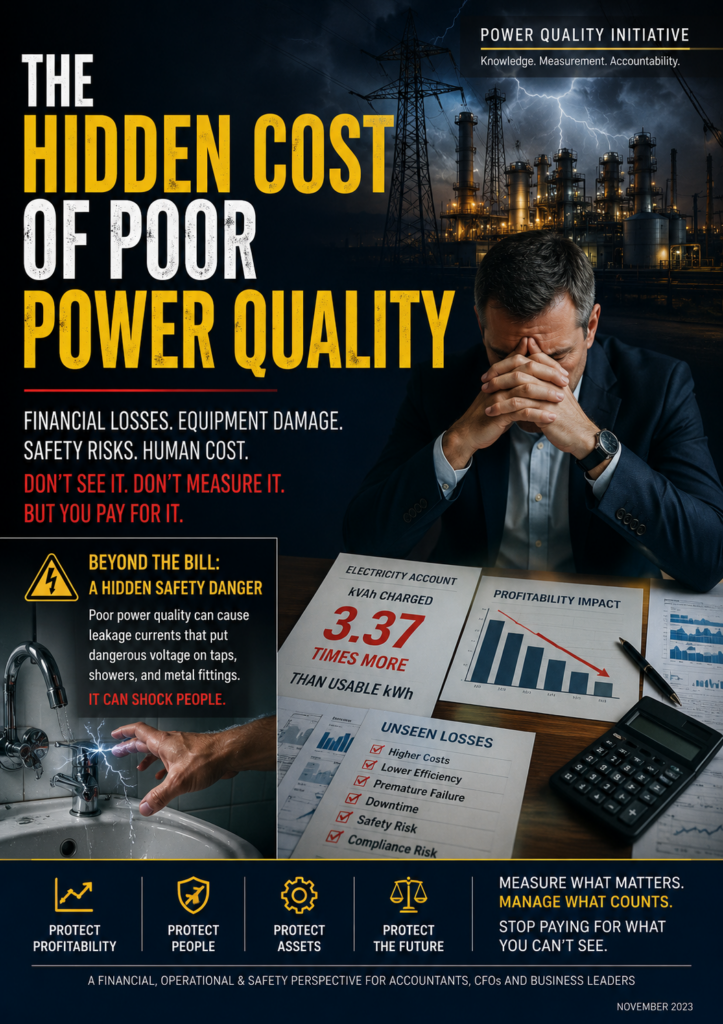
In a recent diagnostic analysis of a 6.6 kV cable feeder, the data revealed a shocking reality: the ratio of kVA to kW was a staggering 3.37:1.
Bottom Line: The businesses fed by that network were paying roughly 237% more for their electricity than they ought to. They were paying more than triple the price for energy that was doing absolutely zero useful work.
This isn’t an isolated anomaly. This is happening globally. From heavy industrial hubs to commercial centers, businesses are hemorrhaging cash to pay for “phantom” power—energy that manifests only as destructive heat and system strain.
The “Symmetrical Components” Illusion
Why isn’t this caught? Because traditional monitoring is blind to it.
When a network becomes unbalanced, it splits into what engineers call symmetrical components, specifically Negative Phase Sequences (NPS). These negative sequences act like a brake on your electric motors, creating counter-torque. Your equipment has to fight against the very power feeding it just to keep turning.
When you sense something is wrong and launch a formal complaint with your power utility, a predictable script unfolds:
- You pay out of pocket to have the electricity meter tested. The result? The meter is functioning perfectly.
- Technicians check the voltages at the local substation using standard panel meters. The result? “Everything is within limits.”
Here is the trap: standard utility equipment is often too rudimentary to detect phase-shift variations and high-frequency harmonics. They are measuring average quantities, completely missing the destructive, unbalanced waves tearing through the system. The system declares itself “healthy” while your bottom line bleeds out.
It’s Not Just Big Business: The Micro-Grid Epidemic
Think this is strictly an industrial problem? Think again. The crisis extends directly to single-phase residential and light-commercial users.
Modern smart meters are increasingly tracking consumption in kVAh (Apparent Power Hours) rather than the traditional kWh (Kilowatt Hours). When the grid is distorted by nearby industrial activity or poor infrastructure maintenance, everyday consumers inherit the financial penalty. Data from municipal areas reveals everyday consumers experiencing unexplained doublings of their electricity accounts, all traceable back to the exact same systemic grid unbalances.
Beyond the Balance Sheet: The Hidden Lethal Threat
The cost of this complacency isn’t measured solely in Dollars, Rands, or Euros. It has a terrifying human cost.
When harmonic disturbances and severe phase unbalances go unchecked, the excess current must find a path to the earth. In a healthy system, infrastructure handles this safely. But in a severely degraded power quality environment, these massive current leakages begin to migrate.
They infiltrate the structural steel of buildings. They hitch a ride on metallic water piping.
The result? Unsuspecting people are getting electrical shocks simply by touching their bathroom taps, kitchen sinks, or shower heads. What is brushed off as a “tingle” in a staff restroom or a factory change-room is actually a glaring red alert. It means your facility’s power quality has degraded to the point that current is actively leaking into human touchpoints. It is a catastrophic safety hazard waiting to happen.
Wake Up to Reality
Ignoring power quality is no longer just an engineering oversight; it is a failure of fiduciary duty and corporate safety oversight.
- To the Engineers: Stop relying on basic multi-meter readings. Demand deep-dive symmetrical component and harmonic analysis.
- To the CFOs: Stop signing off on skyrocketing utility bills as an unavoidable “cost of doing business.”
The data doesn’t lie. Unbalanced networks are draining your capital, burning out your assets, and compromising the physical safety of your people. It’s time to stop paying for power you can’t use, and start demanding accountability from the power utility companies.
Also read: Balancing the Unbalanced
