Best Practices, Power Quality Consulting, Power Quality Matters, Power Quality Monitoring
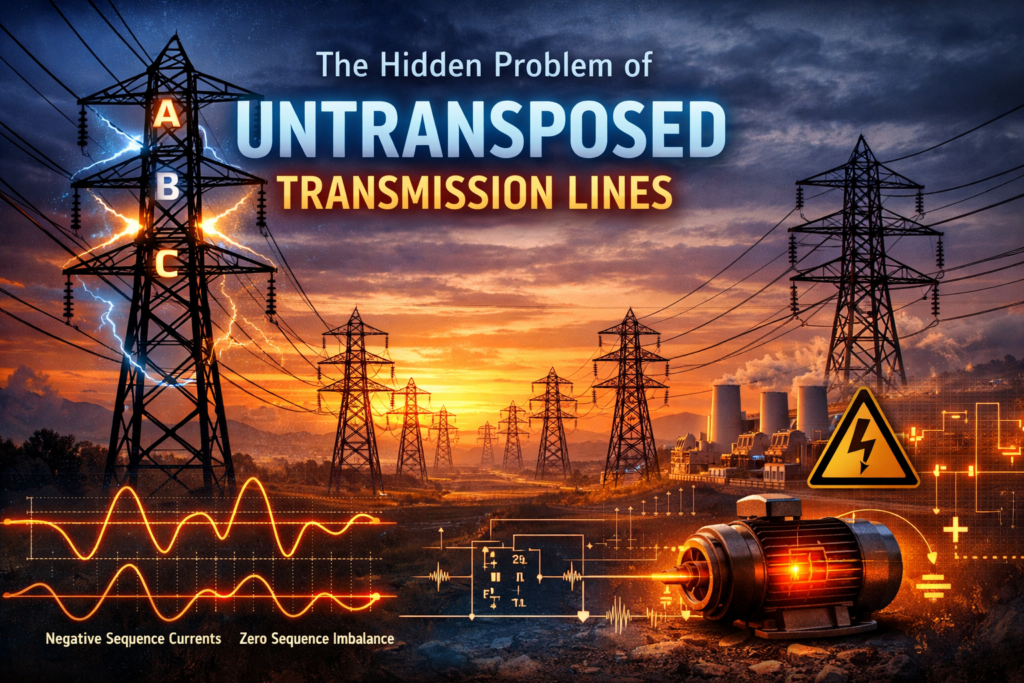
The Hidden Impact of Untransposed Transmission Lines
Mar
Electric power networks are engineered around one foundational assumption: three-phase symmetry. When the electrical parameters of each phase are perfectly equal, currents divide evenly, voltages remain stable, and multi-million dollar equipment operates at peak efficiency.
But what happens when that symmetry quietly disappears?
One of the most overlooked sources of imbalance in modern high-voltage networks is the untransposed transmission line. From the ground, these lines look perfectly ordinary. Yet, their physical geometry introduces subtle, invisible electrical distortions that ripple through the grid—quietly degrading protection systems, shortening equipment lifespans, and compromising power quality.
In an era dominated by renewable generation, power electronics, and ultra-sensitive loads, this hidden phenomenon is transforming from a minor nuisance into a significant operational risk.
Let’s uncover what is really happening behind the steel pylons.
Why Transmission Lines Are Naturally Asymmetrical
A typical three-phase overhead transmission line consists of three conductors supported by towers. Because of structural and mechanical constraints, these conductors are rarely positioned symmetrically with respect to one another or the ground.
Consider a standard horizontal configuration:
Because each phase occupies a unique physical coordinate in space, every conductor experiences a completely different electromagnetic environment:
- Unequal distances to adjacent phases (d1 ≠ d3)
- Varying heights and distances to the ground plane
- Asymmetric coupling to overhead shield/earth wires
- Dissimilar electromagnetic field interactions
These geometric differences create unequal impedance parameters for each phase. Mathematically, the impedance matrix (Z) of a three-phase line can be cleanly represented by:
For a perfectly symmetrical line, the self-impedances are identical (Zaa = Zbb = Zcc) and the mutual electromagnetic couplings are beautifully balanced (Zab = Zbc = Zca). In real-world overhead infrastructure, this symmetry does not naturally occur. Without intentional intervention, each phase develops a slightly different impedance over the length of the corridor.
The Engineering Solution: Line Transposition
To correct this inherent geometric imbalance, utilities historically used line transposition. This process requires conductors to periodically swap physical positions along the right-of-way so that each phase occupies each tower position for exactly one-third of the total line length.
By averaging the geometric layout across the entire line length, the total average impedance experienced by each phase becomes mathematically equal:
The line now behaves like a perfectly symmetrical system, despite the asymmetrical tower architecture.
If transposition fixes the problem, why are so many lines across global grids left untransposed? In many transmission networks, full transposition is intentionally omitted due to real-world constraints: skyrocketing structural costs of transposition towers, higher mechanical failure risks at structural stress points, right-of-way corridor space limitations, and historical legacy assumptions that shorter corridors wouldn’t experience significant unbalance accumulation.
The Hidden Consequence: Sequence Component Infiltration
In a perfectly balanced three-phase system, only positive-sequence currents and voltages exist. However, when an asymmetrical impedance profile is introduced, mathematical symmetrical components reveal the emergence of two dangerous intruders: Negative-Sequence and Zero-Sequence components.
Studies show that untransposed lines produce measurable negative-sequence voltages that scale linearly with loading conditions. Even when the connected load is flawlessly balanced, the line itself creates an unbalance. While a 1% or 2% sequence imbalance sounds negligible, its physical impact on grid infrastructure is profoundly destructive.
Why Sequence Imbalance Matters
| Consequence | Operational Impact | Technical Root Cause |
|---|---|---|
| 1. Machine Heating | Destroys industrial motor insulation and degrades synchronous generators. | Negative-sequence currents create a counter-rotating magnetic field operating at twice the synchronous frequency, causing severe parasitic rotor heating. |
| 2. Voltage Profiles | Causes premature tripping of variable-speed drives and sensitive electronic loads. | Asymmetrical voltage drops along the transmission corridor cause a permanent voltage unbalance at the receiving substation. |
| 3. Protection Blindspots | Causes blind spots in distance protection relays and inaccurate fault location calculations. | Modern digital protection relays rely heavily on symmetrical components; untransposed lines create complex cross-coupling between sequence networks. |
| 4. Neutral Currents | Increases active line losses and causes localized grounding system hot spots. | Geometric unbalance forces residual zero-sequence currents to continuously circulate through transformer neutrals and shield wires. |
Why This Matters More in the Modern Grid
In older grids dominated by massive, rigid synchronous generators, these subtle line asymmetries were easily absorbed. In today’s power systems, the margin for error has vanished.
The modern grid is saturated with Inverter-Based Resources (IBRs) like solar PV plants, wind farms, and battery energy storage systems (BESS). These power-electronic interfaces are exceedingly sensitive to network asymmetries. Small sequence imbalances can trigger negative control-loop interactions with fast inverter controllers, exacerbate harmonic distortion, and cause unexpected voltage stability issues at the point of common coupling.
As networks evolve, the classical engineering assumption of a “perfectly balanced grid” is rapidly becoming an operational liability.
When Should System Planners Worry?
Not every untransposed line requires an immediate engineering overhaul. However, asset managers and planners must perform rigorous three-phase modeling when the following triggers occur:
- Transmission corridors extend over long distances without transposition.
- The lines are pushed to operate near their thermal or stability limits.
- The transmission path serves as an interconnection for large-scale utility renewables.
- Substation SCADA systems register persistent negative-sequence currents during normal operation.
- Distance or differential protection relays behave unexpectedly during routine switching operations.
Note:
Standard commercial power flow software solutions rely on positive-sequence single-line diagrams that inherently assume a balanced network. This means the problem remains completely invisible until a detailed, multi-phase simulation framework is executed.
Balance Must Be Verified, Not Assumed
The greatest operational risk of untransposed transmission lines isn’t their presence—it is their invisibility.
These lines rarely trip breakers instantly. They seldom cause dramatic, explosive structural failures. Instead, they act like a low-grade fever in the grid—quietly bleeding operational efficiency, distorting critical measurement data, and complicating protection system logic.
As the global power grid grows more complex with every inverter and converter connected to it, ignoring structural geometric asymmetry adds an unnecessary layer of risk. For modern power system engineers, the mandate is clear: A balanced grid cannot be assumed. It must be verified.
