
Best Practices, Power Quality Consulting, Power Quality Matters, Power Quality Monitoring
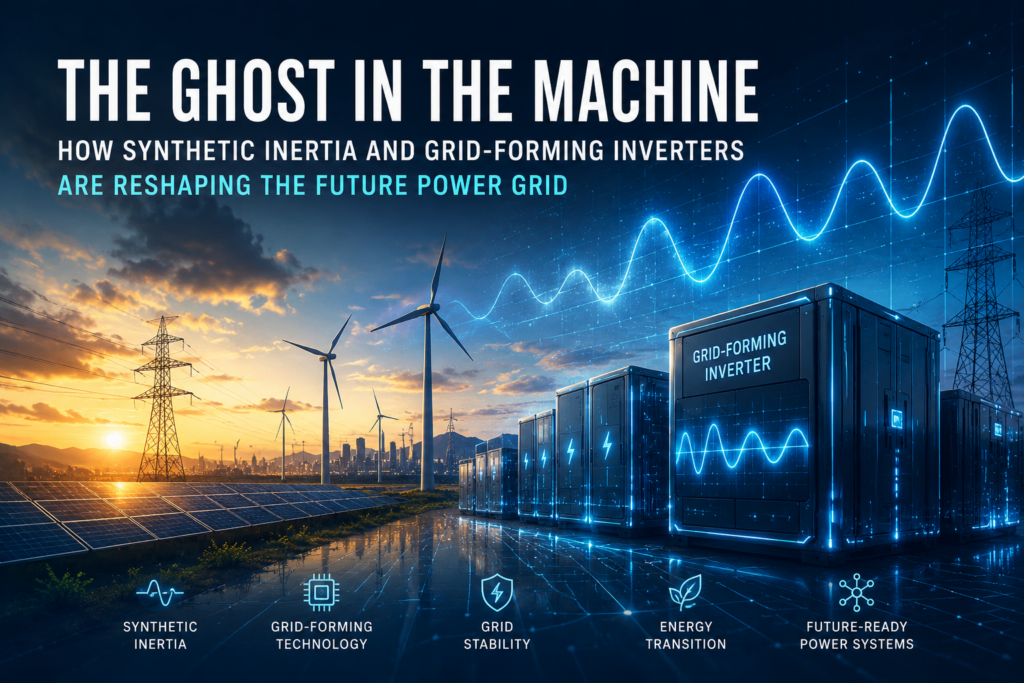
The Ghost in the Machine
Jun
⚡ Executive Summary
As conventional synchronous generators disappear from modern power systems, the grid is losing something far more important than megawatts: physical inertia.
Grid-Forming Inverters, Virtual Synchronous Machines, and Hybrid Synchronous Condensers are emerging as the technologies that may ultimately replace the stabilizing role of rotating machinery. The future of grid stability is becoming increasingly programmable.
The Silent Crisis Nobody Sees
The energy transition is changing the physics of electricity itself.
For more than a century, power systems depended on massive rotating machines. Every turbine rotor acted as a spinning reservoir of kinetic energy, naturally resisting disturbances and stabilizing system frequency.
As renewable energy deployment accelerates, those machines are being retired and replaced by inverter-based resources. While cleaner and more efficient, these resources contribute little or no physical inertia to the grid.
⚡ Lower SCR
Short-Circuit Ratios are declining, making networks increasingly weak and sensitive.
⚠ Higher RoCoF
Frequency changes occur faster, reducing available reaction time.
🔋 More IBRs
Power electronics are rapidly replacing mechanical inertia.
Physics vs Software
The battle that will define the future of grid stability
| Feature | Synchronous Condenser | Grid-Forming Inverter |
|---|---|---|
| Inertia Source | Physical Rotating Mass | Software Algorithms |
| Response Method | Newtonian Physics | Virtual Swing Equation |
| Fault Current | 3–10 pu | 1.1–1.2 pu |
| Energy Storage | Not Required | Required |
“Software can now emulate the behavior of a 100-ton rotor using nothing more than silicon, mathematics and code.”
Takeaway #1
Your Inverter Can Emulate Inertia Without a Battery
University of Alberta researchers demonstrated that a double-stage inverter’s DC-link capacitor can behave as a physical analog of rotor inertia.
This approach significantly reduces capital costs by eliminating the need for dedicated battery storage solely for inertia support.
Takeaway #2
The Oscillation Trap
Synthetic inertia is not automatically beneficial. Delayed control loops can produce anti-phase responses that amplify disturbances rather than damp them.
⚠ Consultant’s Insight
High virtual inertia values combined with poor damping design can create oscillatory instability. Hardware-in-the-loop validation is no longer optional.
Takeaway #3
Programmable Physics Is Here
Virtual Synchronous Machines represent a profound shift in power engineering. Unlike physical rotors, their inertia can be adjusted dynamically to match system conditions and grid code requirements.
Takeaway #4
The Hybrid Goldilocks Solution
Research increasingly points toward Hybrid Synchronous Condensers as the optimal compromise between physical robustness and software agility.
By combining rotating machines with Grid-Forming BESS technology, operators gain superior fault performance, faster settling times, black-start capability and enhanced flexibility.
The End of the Must-Run Era
The future grid will not be stabilized solely by steel, copper and spinning turbines. It will increasingly rely on software-defined physics delivered by advanced control systems.
Grid stability is becoming a programmable service rather than a by-product of conventional generation.
Are we ready to trust civilization’s most critical infrastructure to software capable of mimicking the laws of physics?
