Consulting Services, Power Quality Consulting, Power Quality Matters, Power Quality Monitoring, Solar Electric Power
The Sunlight Tax and Secret Billion-Rand Deals
Sep
5 Shocking Takeaways from South Africa’s Electricity Legal Wars
For years, South Africans have been told that the solution to a collapsing national grid is private initiative. We were encouraged to bleed our own savings into rooftop solar to keep the lights on and relieve pressure on a failing state utility. Yet, in a cruel and calculated irony, those who successfully achieved energy independence are now being hunted by the very authorities they sought to escape.
Recent high-stakes battles in the North Gauteng High Court have unmasked a regulatory environment in total crisis. From “secret” settlements that would have vaporized billions in consumer wealth to blatant attempts to tax the sun itself, the veil of transparency has been torn back. These aren’t just legal disputes; they are a desperate attempt by “cash cow” municipalities and a complicit regulator to punish self-sufficiency.
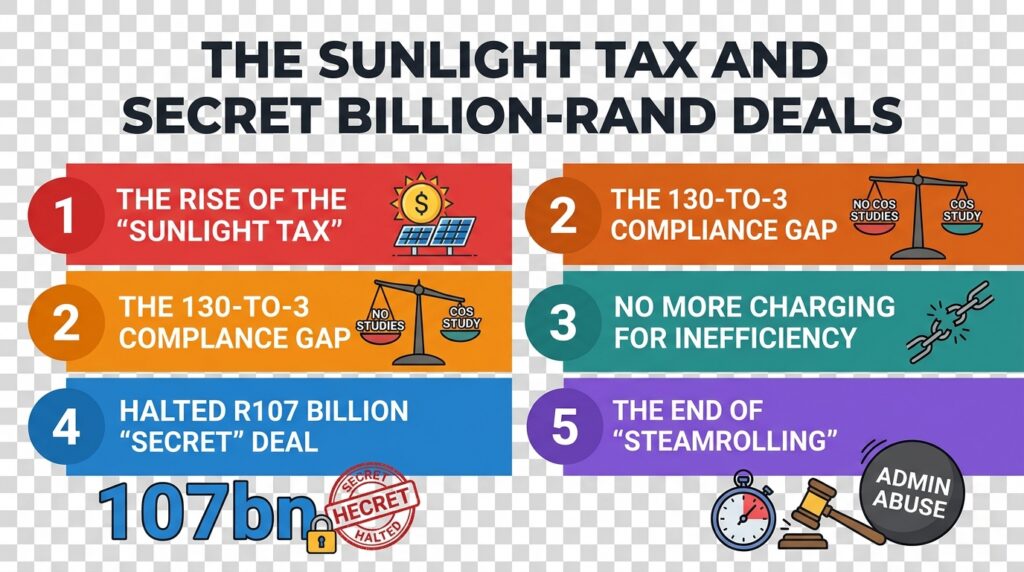
Takeaway 1: The Rise of the “Sunlight Tax”
In the Thaba Chweu Local Municipality, residents who invested in solar panels to escape grid instability were met with a predatory new charge: a fixed monthly levy of R582.64. The sheer audacity of this “Sunlight Tax” is best illustrated by its enforcement: the municipality has been charging this fee even on households that are completely disconnected from the municipal grid.
This isn’t an isolated extortion attempt. The Emfuleni Local Municipality recently tried to steamroll a R2,400 solar registration fee alongside a R463 monthly fixed charge. These levies represent a dangerous administrative precedent—punishing residents for a service they literally do not receive. It is a regulatory fiction designed to bridge the gap caused by years of municipal debt and administrative abuse.
“This is an unlawful, irrational, and unreasonable tax on sunlight.”
Takeaway 2: The 130-to-3 Compliance Gap
The “Cost-of-Supply” (COS) study is the only legal shield consumers have against arbitrary price hikes. By law, tariffs must reflect the actual, efficient cost of distribution, not a thumb-sucked number used to balance a failing budget. Yet, the investigation into NERSA’s 2025/2026 tariff approval process unmasked a massive regulatory fraud.
While NERSA publicly claimed that 130 municipalities had submitted the required COS studies, the truth was far more scandalous: only three municipalities had actually provided complete, lawful studies. The other 127 submitted nothing more than “watered-down explanations” that lacked any accounting rigour.
The Actionable Reality for Consumers
According to the landmark AfriForum v NERSA 2024 ruling, if your municipality failed to submit a compliant COS study, they are legally prohibited from raising your rates. Only 66 municipalities in the entire country were found to be compliant at the time of the order. If yours isn’t one of them, your municipality must continue to levy rates based on the 2023/2024 tariffs. Any increase beyond that is a R-billion-rand illegality.
Takeaway 3: No More Charging for Inefficiency
For too long, NERSA’s methodology allowed municipalities to treat electricity bills as a subsidy for their own incompetence. A major victory by the Pietermaritzburg and Midlands Chamber of Business and the Nelson Mandela Bay Business Chamber has finally put an end to this “inefficiency tax.”
The High Court unmasked a methodology that essentially forced consumers to pay for “rampant electricity and cable theft” and a systemic “lack of infrastructure maintenance.” The court’s ruling is clear: tariffs must be based on the efficient cost of distribution. Municipalities can no longer pass the bill for their own decay onto the ratepayer.
“This case will potentially impact the determination and approval of electricity tariffs charged by municipalities across the country, ultimately benefiting all South African businesses and consumers.”
Takeaway 4: The Halted R107 Billion “Secret” Deal
In late 2025, NERSA and Eskom attempted a financial maneuver so egregious it bordered on the conspiratorial. Claiming a “calculation error” in NERSA’s adjudication of Eskom’s allowable revenue, the two entities tried to settle a dispute behind closed doors. This “secret” deal would have hiked tariffs by nearly 9% without a single minute of public consultation.
While the settlement attempt was pegged at R54 billion, the shock figure now on the table is a staggering R107 billion. Had this deal been made a court order, the impact on your pocket would have been devastating:
Analysts suggest that once the full R107 billion is recalculated into the system, the actual jump could hit 10% to 11%. The court rightly rejected this attempt to “negotiate away the rights of electricity consumers,” affirming that transparency is a non-negotiable component of lawful regulation.
Takeaway 5: The End of “Steamrolling” via Binding Timelines
NERSA and Eskom have spent years “steamrolling” consumers by submitting applications so late that public participation becomes a hollow, box-ticking exercise. The North Gauteng High Court has finally ended this malfeasance by imposing a strict regulatory regime with binding annual deadlines.
These timelines protect your right to participate before municipal budgets are finalized. Crucially, the court now requires that the ERTSA (Retail Tariffs Structural Adjustments Application)—the document that dictates the very structure of your bill—be submitted early enough for real scrutiny.
Key Binding Dates for the Electricity Calendar
- 31 August Deadline for Eskom to submit its ERTSA application.
- 31 January NERSA must notify municipalities in writing of wholesale tariffs.
- 20 March Final deadline for municipalities to submit tariff applications to NERSA.
- 5 May NERSA must issue final decisions and communicate reasons immediately.
