
Best Practices, Power Quality Consulting, Solar Electric Power
The Boiling Frog Syndrome
Aug
The Boiling Frog Syndrome: How Regulatory Creep Threatens South Africa’s Energy Future
Executive Summary
South Africa’s electricity sector stands at a critical juncture. After years of energy insecurity, private enterprise and residential consumers responded by investing heavily in distributed generation—primarily rooftop solar and battery storage. However, recent regulatory proposals and policy signals threaten to stifle this transition. By framing private generation as a threat to state entities rather than a catalyst for economic growth, regulatory interventions risk creating a system that protects monopolies at the expense of market efficiency, economic expansion, and energy independence.
The Boiling Frog Metaphor
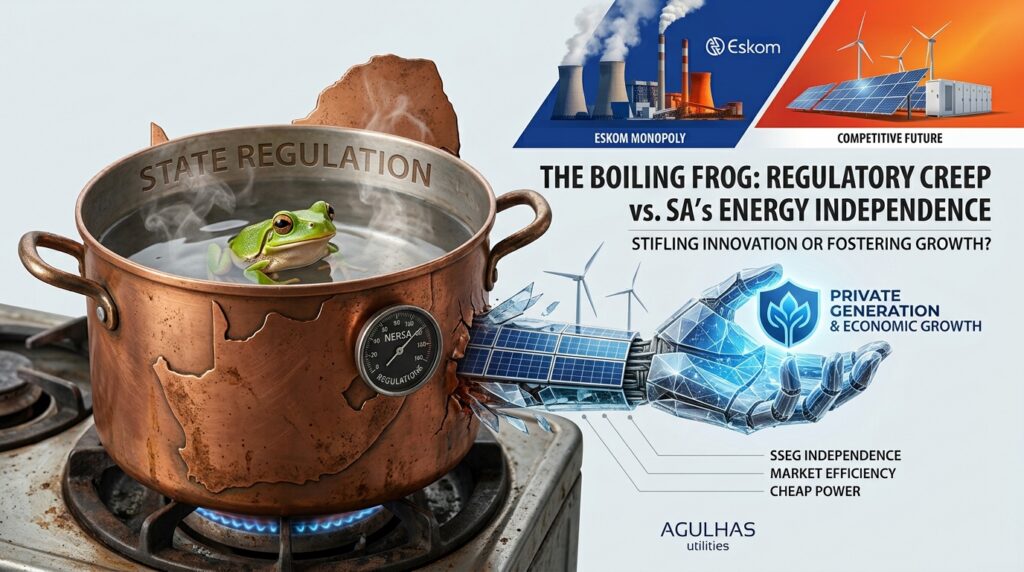
There is a well-known allegorical tale regarding a frog placed in a vessel of water that is gradually heated. Because the temperature increases by imperceptible increments, the frog fails to perceive the impending threat until its capacity to act is entirely compromised.
In economic and political policy, this phenomenon manifests as “regulatory creep”—the subtle, incremental expansion of administrative control that slowly erodes market efficiency and private initiative.
The critical question facing South Africa’s energy landscape today is simple: Are we witnessing the incremental “boiling” of private energy independence?
“Regulation must exist to facilitate economic efficiency and system reliability, not to shield inefficient state monopolies from competitive market forces.”
Two Troubling Signals for Private Generation
Recent regulatory proposals from the National Energy Regulator of South Africa (NERSA) and statements from the Ministry of Electricity and Energy indicate a concerning shift toward protectionism.
1. The SSEG Registration Mandate
NERSA has drafted rules requiring all electricity distributors—including Eskom and licensed municipal distributors—to compile and maintain formal registers of all Small-Scale Embedded Generation (SSEG) facilities under 100 kW within their supply areas.
While grid visibility is undeniably necessary for operational stability, the structural concern lies in how this data will ultimately be utilized. Mandatory registration often serves as the precursor to:
- Punitive grid access tariffs and fixed-charge restructuring.
- Administrative bottlenecks for small-scale installations.
- Eventual taxation or curtailment of private solar investments.
2. Protecting the Sovereign Monopoly
Compounding this regulatory push, Minister of Electricity and Energy Kgosientsho Ramokgopa publicly signalled an intention to introduce “drastic measures” to protect Eskom against private sector competition as the country transitions toward an open market.
This policy direction presents a fundamental paradox:
- Market Realities: Eskom currently controls approximately 70% of generation capacity and maintains a near-total monopoly on national transmission infrastructure.
- The Policy Framing: The state frames Eskom—the dominant market participant—as the party at a disadvantage, rather than the private developers and consumers who stepped in to bridge the state’s capacity deficit.
The Economic Misalignment: Protecting Monopolies vs. Enabling Growth
In a well-functioning market, the primary objective of energy policy is straightforward: achieve the lowest possible cost of electricity to maximize macroeconomic growth. Cheaper, reliable energy lowers operational overheads for business, drives industrialization, creates employment, and improves overall social welfare.
When policy shifts from enabling competition to protecting a state-owned enterprise, market distortions occur. Protecting a state utility from competitive forces shifts the financial burden directly onto consumers and businesses through higher tariffs and suppressed innovation.
Where Reform Must Begin
Before implementing legislative and regulatory barriers to shield state infrastructure from private competition, the focus must shift inward toward structural operational reform within state utilities:
- Bureaucratic Streamlining: Reducing administrative redundancies and operational overheads within state utilities.
- Depoliticization: Eliminating political interference and cadre deployment in technical decision-making processes.
- Efficiency and Competitiveness: Aligning operations with strict commercial merit, technical capability, and procurement efficiency.
Key Takeaways
- Focus on System Efficiency: Energy regulation must prioritize least-cost, reliable generation above entity protection.
- Support Private Capital: Private investment in SSEG relieved severe grid pressures during power deficits and must be integrated cleanly, not penalized.
- Internal Utility Reform First: Utilities must achieve competitiveness through operational efficiency rather than legislative protectionism.
Conclusion
Regulating grid safety, power quality, and technical compliance is a core necessity for a modern power system. However, using regulatory frameworks to restrict competition or penalize private energy generation will ultimately harm South Africa’s broader economic potential.
To achieve sustainable growth, South Africa must foster an environment where state and private entities compete on a level playing field—driving down costs and securing a resilient energy future for all.
