
Electrical foundations
Build a working vocabulary for voltage, current, frequency, RMS values and three-phase systems. Keep line-to-line and phase-to-neutral quantities distinct.
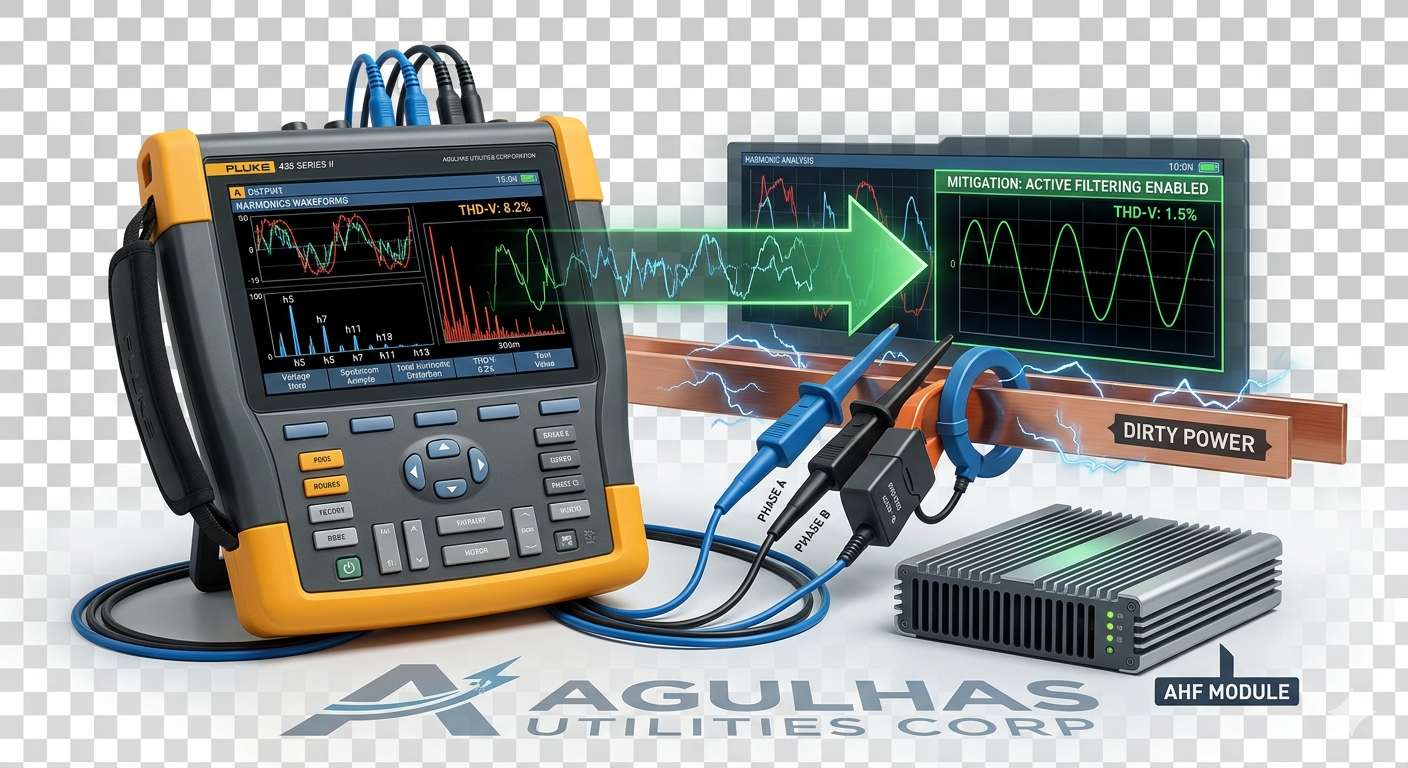
Build a practical foundation in power quality with Agulhas Utilities Corporation. This basic-level course introduces electrical disturbances, harmonics, three-phase unbalance and the interpretation of measurement records.
Understand the disturbance. Read the evidence. Ask better engineering questions.
A practical introduction to power quality for technical teams, maintenance personnel and facilities decision-makers. Build a clear foundation before progressing to specialist analysis.
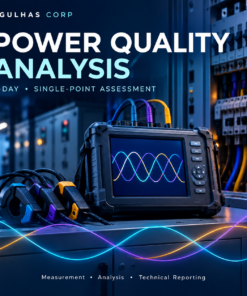
Conceptual three-phase illustration only. Not measured data, a compliance assessment or a fault simulation.
A proposed foundation syllabus that connects everyday operating questions with the language of power quality. Final emphasis is agreed before booking.
Build a working vocabulary for voltage, current, frequency, RMS values and three-phase systems. Keep line-to-line and phase-to-neutral quantities distinct.
Meet voltage dips, swells, interruptions, transients and frequency variations. Practise describing an event without jumping to a cause.
Explore fundamental and harmonic components, voltage and current distortion, and an introductory distinction between power factor and distortion.
Introduce voltage and current unbalance, negative and zero sequence, and why a magnitude-deviation index is not the same as a sequence-based measure.
Work through illustrative waveforms, RMS trends and event logs. Identify measurement location, instrument suitability, capture settings and reporting intervals.
Organise observations, test alternative explanations and decide what further investigation is needed. Introduce mitigation categories without prescribing a universal fix.
The course is designed to help participants explain what was observed, identify what the available records do not establish, and prepare a more useful request for investigation.
Examples are educational and explicitly labelled. Training does not establish the cause of a disturbance at your site or guarantee equipment reliability.
Work through a hypothetical equipment-trip scenario. The aim is a disciplined enquiry—not a premature verdict.
Record the equipment response, reported time and operating condition.
Review the illustrative event log, measurement point and settings.
List missing records and competing explanations without assigning blame.
Draft a focused request for specialist assessment or further measurement.
Proposed educational exercise. Not a documented customer incident or a site-specific engineering conclusion.
Suitable as an introduction for electrical technicians, maintenance teams, facilities personnel, junior engineers and operational managers who engage with electrical performance issues.
Basic familiarity with electrical systems is helpful. Advanced power-system modelling is outside the proposed foundation scope.
No. This is a new basic-level course designed to establish terminology, measurement literacy and a structured approach to asking technical questions. Advanced modelling, protection-setting design and specialist mitigation design are outside its proposed scope.
No site survey, instrument installation, live measurements, site-specific compliance report or electrical remedial work is included unless separately scoped and quoted.
No. Training is not a compliance assessment, legal opinion, competency authorisation or guarantee of equipment performance. Applicable South African requirements and relevant international standards are introduced as context; their editions and applicability must be checked for each actual assessment.
No CPD points, formal qualification or accredited certification are promised. Ask about any attendance record and its conditions when requesting a quotation.
Submit an enquiry with your team size, preferred dates, delivery location or online preference, and learning priorities. Fees, taxes, travel where applicable, payment arrangements and booking or cancellation conditions must be confirmed in writing before acceptance. An enquiry alone does not reserve a training date.
Tell us who will attend, what they need to understand and how you would like the training delivered. We will use that brief to scope the appropriate foundation course.
Enquiry-based training • Scope and availability confirmed before booking
| Course level | Basic / Foundation |
|---|---|
| Booking | Enquiry and quotation |

Power Quality Consulting Services
Power Quality Consulting Services
Enforce Grid Accountability Support — Back the Future of Transparent Power Systems
Documents

Training
Power Quality Analysis