
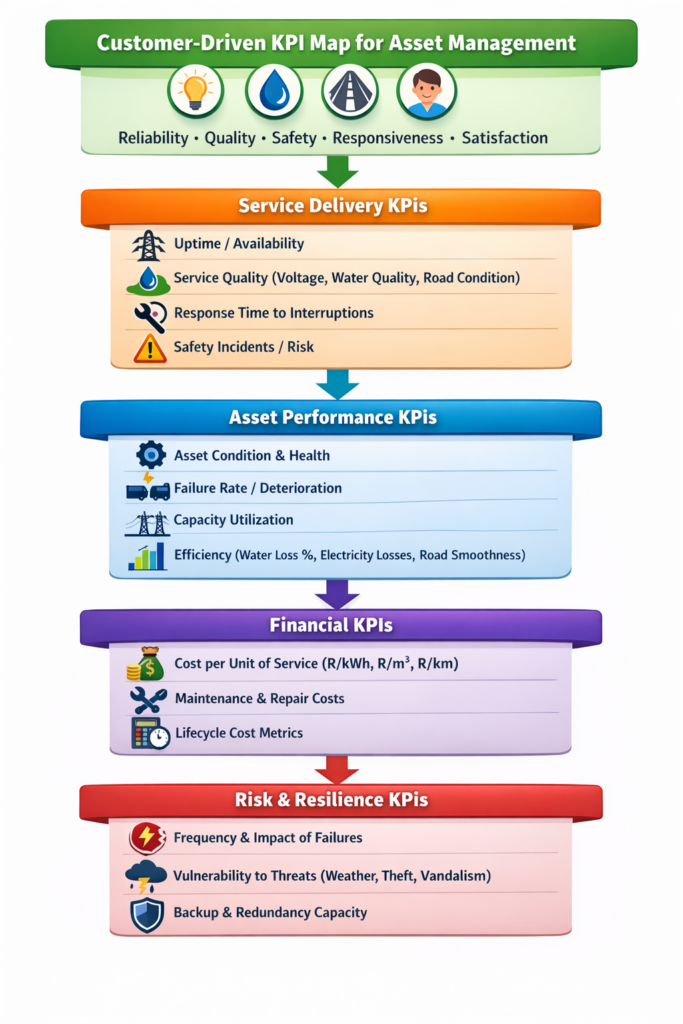
In asset management, particularly for critical infrastructure like electricity, water, and roads, the starting point of any effective strategy is understanding customer expectations. After all, assets exist to serve people, communities, and businesses. Without meeting these expectations, even the most well-maintained systems can fail to deliver value.
Customer-Driven KPI Map identifies customer expectations as the foundation upon which all other performance metrics are built. Let’s explore the key dimensions that define these expectations.
1. Reliability of Service
Customers expect their essential services to be available when needed. For electricity, this means minimizing outages and ensuring stable supply. For water, it means consistent flow and pressure, and for roads, it’s accessibility and uninterrupted connectivity.
- Why it matters: Reliable services reduce disruptions to daily life and economic activity, improving overall satisfaction.
- How it’s measured: Common metrics include uptime percentages, frequency of outages, and average restoration times.
2. Quality of Service
Beyond availability, customers care about how well the service performs. Electricity should have stable voltage without surges; water should be clean, safe, and free from contaminants; roads should be smooth and safe for all types of vehicles.
- Why it matters: Poor quality impacts safety, health, and productivity, leading to dissatisfaction and complaints.
- How it’s measured: Voltage stability, water purity levels, road surface conditions, and similar technical benchmarks.
3. Responsiveness
When interruptions or issues occur, customers expect prompt and effective responses. This includes timely communication, quick repairs, and proactive notifications.
- Why it matters: Efficient response builds trust and demonstrates that the service provider values its customers.
- How it’s measured: Response times to faults, complaint resolution times, and feedback on customer service interactions.
4. Safety and Risk Perception
Customers want assurance that their environment is safe and secure. For electricity, that might mean properly insulated cables and secure substations. For water, it’s ensuring pipelines are free from contamination or leaks. For roads, it’s clear signage, well-maintained surfaces, and accident prevention measures.
- Why it matters: Safety directly affects public confidence and legal compliance. Perceived risks can heavily influence satisfaction even if incidents are rare.
- How it’s measured: Number of incidents or accidents, hazard reports, and risk assessment scores.
5. Customer Satisfaction
Ultimately, all these elements converge in overall satisfaction. Customers form perceptions based on reliability, quality, responsiveness, and safety, and these perceptions dictate loyalty, complaints, and advocacy.
- Why it matters: Satisfied customers are more forgiving of occasional lapses and are likely to engage positively with the service provider.
- How it’s measured: Surveys, Net Promoter Scores (NPS), complaint volumes, and feedback ratings.
Why Customer Expectations Matter in Asset Management
Starting with customer expectations ensures that all subsequent KPIs are meaningful. Asset performance, financial efficiency, and risk mitigation strategies are only valuable if they align with what customers truly need. By understanding expectations upfront, utilities and infrastructure managers can prioritize investments, maintenance, and innovations that deliver tangible benefits to the people they serve.
Investing time in defining and measuring customer expectations is the first step in creating a truly customer-centric asset management framework. It sets the stage for informed decisions on service delivery, asset health, cost efficiency, and resilience.
💡 Takeaway:
Customer expectations are not abstract ideals—they are measurable, actionable, and central to effective asset management. Focusing on reliability, quality, responsiveness, safety, and satisfaction ensures that infrastructure investments truly serve the communities that depend on them.
Enterprise Asset Management Consulting