
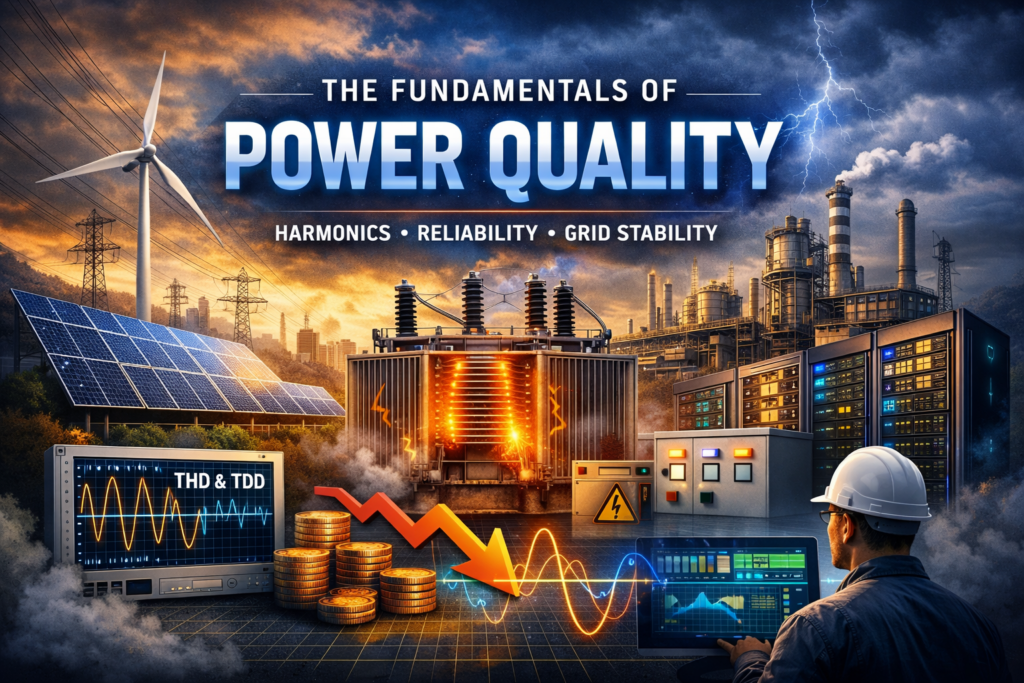
Why Harmonics Are Not “Technical Noise” — But a Strategic Business Risk
Power quality is often treated as an engineering detail buried deep inside technical compliance documents. In reality, it is a financial, operational, and governance issue that directly affects reliability, efficiency, asset life, and enterprise risk.
Modern electrical networks are no longer dominated by simple linear loads. They are filled with electronic converters, drives, switch-mode power supplies, inverters, and automation systems. These technologies improve efficiency and control — but they fundamentally change how current is drawn from the grid.
The result? Harmonic distortion.
And harmonic distortion is no longer optional background noise — it is an engineered consequence of how we use electricity.
What Is Harmonic Distortion?
In an ideal system, voltage and current waveforms are perfectly sinusoidal at the fundamental frequency (50 Hz in South Africa and most of the world).
Harmonics are additional frequency components that are integer multiples of the fundamental frequency:
- 2nd harmonic = 100 Hz
- 3rd harmonic = 150 Hz
- 5th harmonic = 250 Hz
- 7th harmonic = 350 Hz
…and so on.
When these harmonic currents are superimposed onto the fundamental waveform, the result is distortion.
Two key measurements define this distortion:
🔹 Total Harmonic Distortion (THD)
THD measures the ratio of harmonic content to the fundamental component.
It reflects waveform purity.
🔹 Total Demand Distortion (TDD)
TDD measures harmonic current relative to the system’s maximum demand load current.
It reflects network impact under real operating conditions.
In simple terms:
- THD = waveform distortion
- TDD = network stress indicator
How Is Harmonic Distortion Generated?
Harmonics are generated by non-linear loads.
A load is non-linear when the current it draws is not proportional to the applied voltage. Instead of drawing a smooth sinusoidal current, it draws current in pulses.
Common Harmonic Sources:
- Variable Speed Drives (VSDs)
- Rectifiers
- Inverters (solar PV systems)
- UPS systems
- LED lighting
- Switch-mode power supplies
- EV charging infrastructure
- Data centre equipment
- Industrial automation systems
The Root Cause
The core cause of harmonics is power electronic switching.
Modern equipment uses semiconductor devices (IGBTs, SCRs, diodes) that switch rapidly to control power. This switching action creates current pulses rather than smooth current flow. Those pulses mathematically decompose into harmonic frequencies.
So, harmonics are not accidental.
They are a direct by-product of modern energy efficiency technology.
Where Do Harmonics Come From — Exactly?
Harmonics originate:
- Inside the equipment itself (internal rectification stages).
- At the point of common coupling (PCC).
- On the customer’s internal distribution network.
- Increasingly, from distributed generation (e.g., solar inverters).
They are injected into the network by the load and then flow:
- Into upstream transformers
- Through cables and busbars
- Into other connected equipment
- Back toward the utility grid
Harmonics do not stay localized.
They propagate throughout the electrical system.
Who Is Responsible for Their Existence?
The existence of harmonics is the natural consequence of:
- Industrial modernization
- Digital transformation
- Energy efficiency measures
- Renewable energy integration
So, responsibility lies primarily with end users and equipment manufacturers deploying non-linear loads.
However, harmonics are not “fault conditions.”
They are expected electrical phenomena.
Who Is Responsible for Limiting Their Impact?
Responsibility is shared:
🔹 Equipment Manufacturers
Must design equipment to meet harmonic emission standards.
🔹 End Users (Industrial & Commercial Facilities)
Must ensure their installations comply with harmonic limits at the PCC.
🔹 Consulting Engineers
Must design systems capable of handling harmonic loads safely.
🔹 Utilities
Must define acceptable distortion limits and enforce compliance.
Standards such as IEEE 519 define acceptable voltage and current distortion limits to protect the network.
In practice:
The party injecting the harmonic currents is responsible for limiting their impact.
What Harmonics Actually Do to Your Network
Harmonics cause measurable physical consequences:
🔥 Excessive Heating
- Transformers overheat
- Neutral conductors carry triplen harmonic currents
- Cables operate above thermal rating
- Cables operate above thermal rating
⚡ Reduced Power Factor
Distortion lowers true power factor, increasing apparent demand.
🧲 Core Saturation & Magnetic Stress
Transformers experience additional eddy current and hysteresis losses.
🛑 Nuisance Tripping
Protection devices operate unpredictably.
🔄 Capacitor Bank Failures
Harmonics can resonate with capacitor banks, amplifying distortion.
💰 Increased Losses
Harmonic currents increase I²R losses in conductors and transformers.
📉 Asset Life Reduction
Insulation degradation accelerates.
Industry-Specific Impacts
🏭 Manufacturing & Heavy Industry
- Drive-dominated motor loads
- Production interruptions
- Transformer derating
- Equipment overheating
🏢 Commercial Buildings
- Elevator drives
- HVAC systems
- LED lighting networks
- Data and IT equipment interference
🖥 Data Centres
- High concentration of switch-mode power supplies
- Elevated neutral currents
- UPS system stress
- Reduced redundancy margin
☀ Renewable Energy Installations
- Inverter-based generation
- Grid interaction distortion
- Compliance exposure at PCC
🏥 Healthcare
- Sensitive diagnostic equipment
- Voltage distortion sensitivity
- Reliability-critical infrastructure
🚗 EV Charging Infrastructure
- High-power rectification
- Aggregated harmonic injection
- Distribution network stress
Across sectors, the pattern is clear:
The more digitally advanced the facility, the higher the harmonic exposure.
The Business Reality
Harmonics are not just waveform distortion.
They directly influence:
- Equipment lifespan
- Insurance risk
- Downtime probability
- Energy efficiency
- Regulatory compliance
- Capital planning
Ignoring harmonic distortion shifts cost from proactive engineering to reactive failure management.
The Strategic Perspective
Power quality management should not begin after equipment failures. It should begin during:
- Feasibility studies
- Network harmonic modelling
- Engineering simulation
- Design validation
- Lifecycle financial analysis
When treated strategically, harmonic mitigation:
- Reduces long-term capital expenditure
- Improves reliability
- Extends asset life
- Enhances operational stability
- Strengthens governance alignment
Triplen Harmonics
🔌 What triplen harmonics are
Triplen harmonics are defined as:
- Odd multiples of the 3rd harmonic (3, 9, 15, 21…)
- Zero‑sequence components— all three phase currents rise and fall together rather than being 120° apart
- Non‑canceling in a 3‑phase system, unlike most other harmonic orders
In a balanced three‑phase system, most harmonics cancel out because of their phase displacement. Triplen harmonics do not cancel; instead, they add arithmetically in the neutral conductor.
Final Thought
Harmonics are not “someone else’s problem.”
They are the predictable outcome of modern electrical systems.
The question is not whether your network has harmonic distortion.
The question is:
- Have you measured it?
- Have you quantified its cost?
- Have you engineered its mitigation?
Because in today’s electrically complex world,
Power Quality is not an engineering detail — it is a business imperative.
