
Eliminating the “Hidden Tax” of Dirty Power
The Strategic Challenge
In modern utility and industrial environments, the proliferation of non-linear loads
(VFDs, LED lighting, and switch-mode power supplies) introduces harmonic distortion that
erodes system efficiency. This “dirty power” causes excessive heat, nuisance tripping, and
inaccurate metering. Our Harmonic Analysis service provides a forensic engineering roadmap to
reclaim your system capacity and protect your bottom line.
1. Core Business & Operational Benefits
Focus on ROI and Asset Protection
- Reduce Thermal Stress: Lower the operating temperature of cables, motors, and transformers,
directly slowing the degradation of insulation and extending asset life. - Recover System Capacity: Harmonics draw “reactive” current that occupies
transformer and cable capacity without doing useful work. Mitigation allows you to reclaim this
capacity for future expansion. - Eliminate Nuisance Tripping: Identify the root cause of “ghost” trips in circuit
breakers and the premature failure of sensitive control electronics. - Improve Power Factor: Resolve “dirty power” issues that interfere with traditional
Power Factor Correction (PFC) banks, preventing costly resonance events.
2. Technical Scope of Work
What is included in the professional engagement
Our approach follows a rigorous, data-driven methodology to ensure the proposed solutions are both
technically sound and cost-effective:
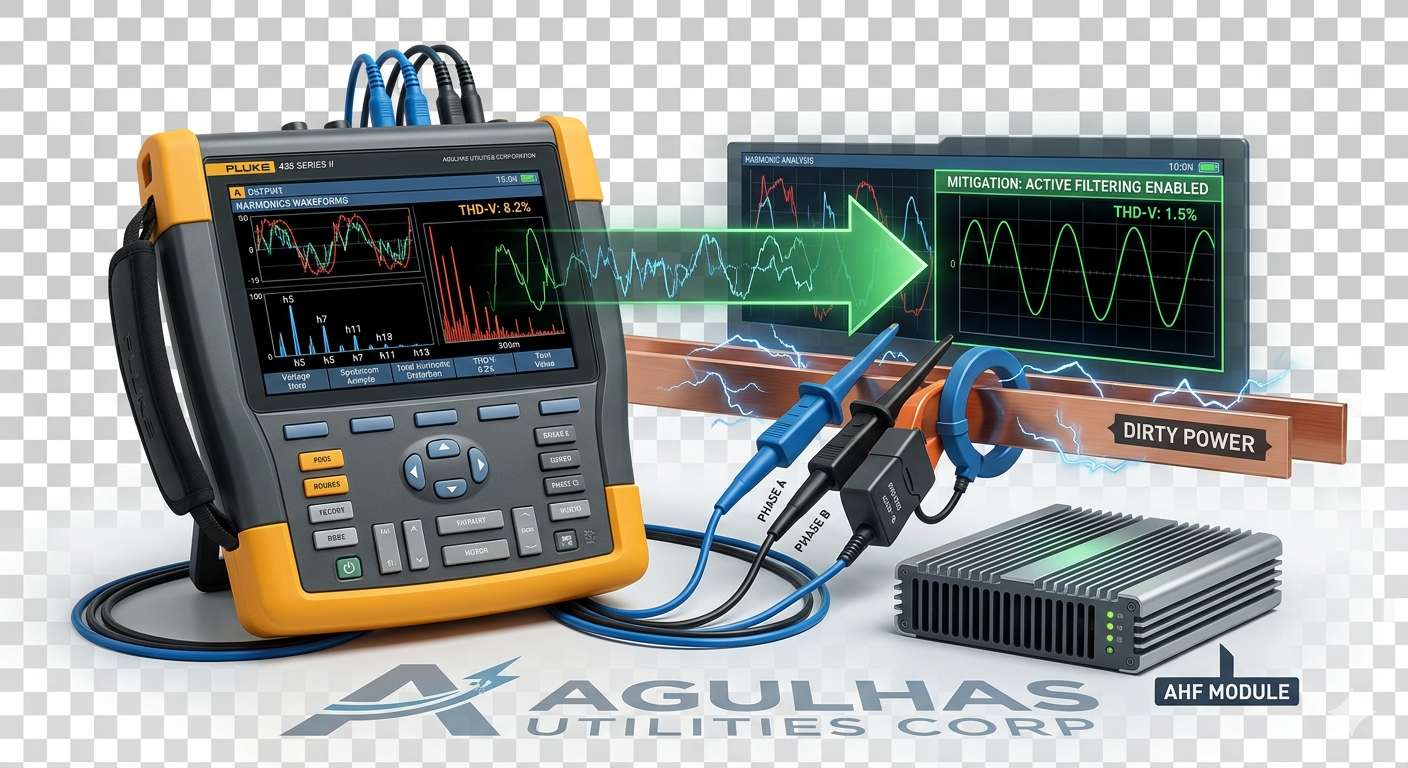
- High-Precision Logging: Deployment of Class A (IEC 61000-4-30) power
quality recorders to capture a representative profile of your system’s harmonic “signature.” - THD & TDD Analysis: Comprehensive calculation of Total Harmonic Distortion (THDv and THDi)
and Total Demand Distortion (TDD) at the Point of Common Coupling (PCC) - Resonance Risk Assessment: Modeling your system to identify potential resonance points between your
distribution transformers and PFC capacitor banks. - Compliance Benchmarking: Detailed comparison of results against NRS 048
and IEEE 519 limits to identify regulatory and safety risks.
3. The Mitigation Roadmap
Engineering solutions, not just data
We don’t just provide a report; we provide a vendor-neutral engineering strategy. Depending on the
analysis results, your roadmap may include:
- Passive Filtering Design: Specification of tuned or de-tuned filter banks to “trap” specific harmonic orders.
- Active Harmonic Filters (AHF): Design of dynamic injection systems for rapidly changing loads.
- Structural & Electrical Modeling: Optional integration of Python-based macros and FreeCAD structural
modeling to assess the physical impact of new mitigation hardware on existing infrastructure. - K-Factor Transformer Specification: Recommendations for specialized equipment in high-harmonic zones.
4. Deliverables
- Executive Summary: A high-level overview of risks and recommended financial investment.
- Full Technical Report: Detailed waveform captures, harmonic spectra, and compliance tables.
- Implementation Plan: A phased approach to mitigation, prioritized by ROI and risk level.