
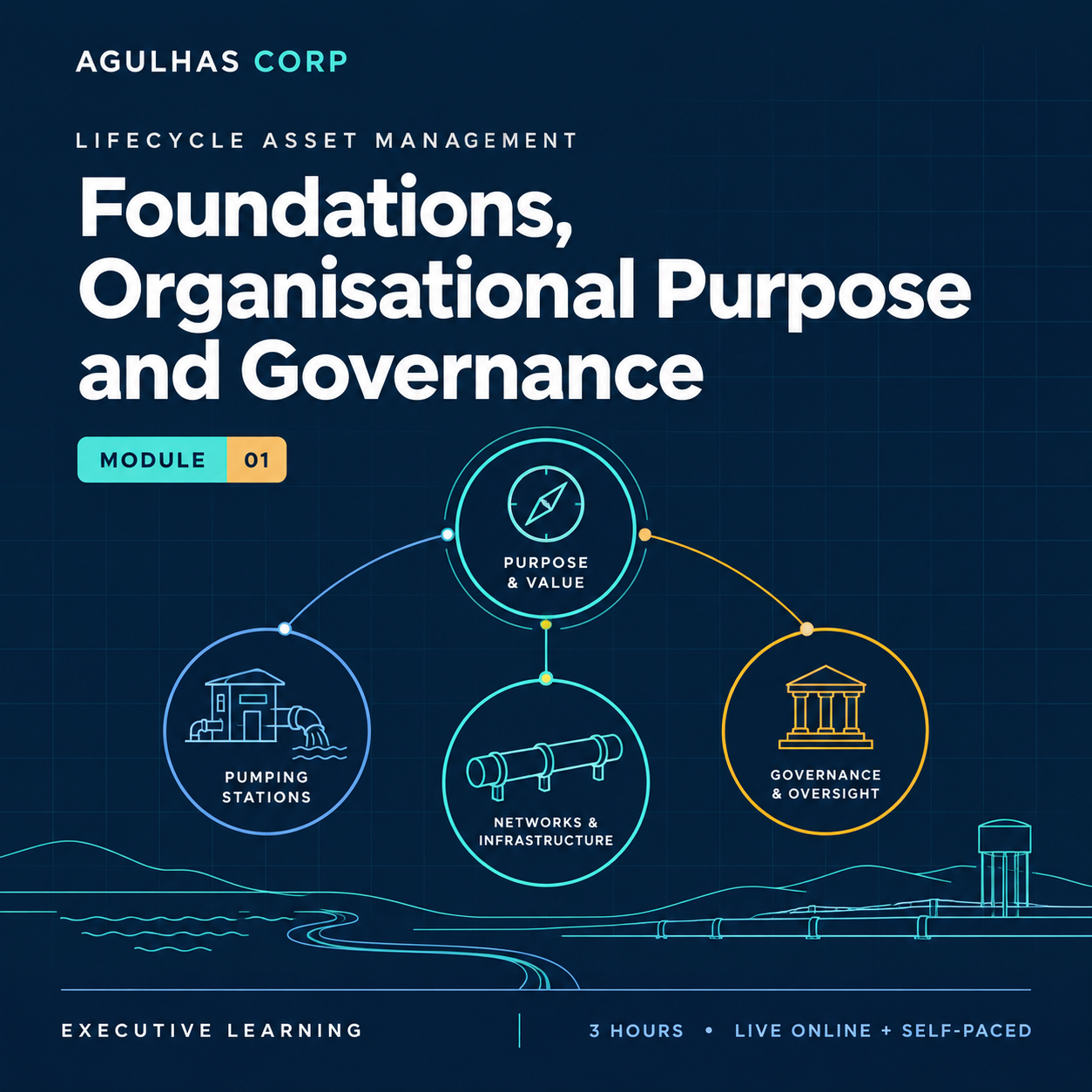
Foundations, Organisational Purpose and Governance
R2,950.00 excl VAT
MODULE 1 · LIFECYCLE ASSET MANAGEMENT FOR EXECUTIVES
Connect physical assets with organisational purpose, service delivery and executive accountability.
Explore asset management foundations, lifecycle decision-making and governance through live online learning, self-paced activities and a practical, fictional utility case study.
- Clarify how assets contribute to organisational objectives.
- Define decision responsibilities, authority and oversight.
- Examine cost, risk, performance and service trade-offs.
- Apply downloadable workbooks and executive decision templates.
Out of stock
AGULHAS UTILITIES · EXECUTIVE CAPABILITY DEVELOPMENT
MODULE 01 / LIFECYCLE ASSET MANAGEMENT
Foundations, Organisational Purpose and Governance
Start with the purpose of the organisation—not simply the equipment it owns. Explore how physical assets support service delivery and how leadership establishes direction, accountability and oversight.
Executive audience · 3 hours total · Blended online learning · Downloadable resources
Establish the foundation for purposeful asset decisions
This opening module develops a shared understanding of lifecycle asset management and its relationship with organisational purpose, stakeholder expectations and governance.
Participants work through the distinctions between physical assets, asset management and an asset management system. They then examine the connection between service outcomes, lifecycle choices, decision authority and the evidence needed to support a recommendation.
The emphasis is executive judgement: framing the right questions, clarifying responsibilities and recognising what remains uncertain before authorising action.
Your learning experience
- Audience: executives, directors and senior leaders overseeing physical assets, infrastructure or utility services.
- Total learning time: 3 hours, comprising a 2-hour live online session and approximately 1 hour of self-paced activities.
- Format: facilitated discussion, executive exercises, independent reflection and downloadable learning resources.
- Access: self-paced materials available for 90 calendar days from enrolment confirmation.
- Prerequisites: no prior asset management qualification required; familiarity with your organisation’s objectives will support participation.
- Scheduling: the live session date and joining instructions will be confirmed before the booking is finalised.
What you will be able to do
- Distinguish an asset, asset management and an asset management system using a practical infrastructure example.
- Map how a selected asset system contributes to organisational purpose and stakeholder service requirements.
- Identify key decisions across the physical asset lifecycle and explain their connection to cost, risk, performance and service.
- Allocate decision responsibilities and identify escalation and oversight requirements in a governance exercise.
- Prepare a concise decision record that distinguishes evidence, assumptions, responsibilities and unresolved questions.
- Identify standards and regulatory matters requiring organisation-specific applicability checks.
INSIDE MODULE 1
From foundational language to executive accountability
01 · Foundations and shared language
Clarify the core concepts and classify examples of assets, asset management activities and management-system arrangements. Establish the physical-asset focus of the programme.
02 · Organisational purpose and service contribution
Identify the service an asset system exists to support. Connect stakeholder needs, organisational objectives and asset-related decisions through a service-contribution map.
03 · The lifecycle decision perspective
Map decisions from service-needs identification through planning, acquisition, operation, maintenance, renewal and disposal. Identify where functions must coordinate their decisions.
04 · Governance, responsibilities and oversight
Allocate responsibility for preparing, approving, implementing and reviewing decisions. Discuss delegated authority, escalation, evidence requirements and the executive oversight role.
05 · Decision records and applicability checks
Record the decision, its purpose, supporting information, assumptions and outstanding checks. Introduce an applicability and verification register without treating unverified obligations as settled compliance conclusions.
The Mhlabeni pumping-station case
Use a fictional pumping-station scenario to establish the service purpose, define the initial system boundary and examine who should make, authorise and review asset-related decisions.
Your task is not to select equipment or approve an engineering design. It is to establish a defensible starting point for subsequent lifecycle planning.
- What service must the asset system support?
- Whose needs and objectives must be considered?
- Who recommends, authorises and reviews action?
- What evidence is missing before the next decision?
Mhlabeni is a hypothetical teaching case. Its activities are educational exercises, not ISO-prescribed procedures or site-specific engineering instructions.
Build your executive decision toolkit
The module workbook brings together six concise learning outputs:
- A concept-classification record.
- A service-contribution map.
- A lifecycle decision map.
- A responsibility matrix.
- An executive decision record.
- A preliminary applicability and verification register.
These outputs are introductory learning artefacts—not an approved asset management plan. Unresolved objectives, boundaries and evidence gaps are carried forward into the next module.
What your enrolment includes
- One scheduled two-hour live online session.
- Approximately one hour of guided self-paced activities.
- A downloadable executive learner workbook.
- The fictional Mhlabeni case-study brief.
- Templates for the six module learning outputs.
- A short knowledge and application review.
- Email-based access and course-content support during the access period.
The package does not include private consulting, an organisational audit, site-specific engineering approval or licensed copies of ISO standards. Session recordings are not included unless expressly confirmed in the booking information.
Standards-informed. Application-focused.
The conceptual reference point is ISO 55000:2024: Asset management — Vocabulary, overview and principles. ISO 55001:2024 is introduced separately as the requirements standard for an asset management system.
Exercises and templates are proposed teaching tools. Participation does not demonstrate organisational conformity, confer ISO certification or establish legal compliance.
Prepare for your session
- Use an internet-connected computer with audio and access to the confirmed online meeting platform.
- Have a recent browser and software capable of opening PDF documents.
- Bring a brief statement of your organisation’s purpose or a service objective you wish to examine.
- Use anonymised examples; do not share confidential organisational or personal information in group discussions.
Please discuss accessibility requirements with us before booking so that available arrangements can be confirmed.
Clear arrangements before you enrol
Booking and payment
Enrolment is confirmed after payment has cleared and the live-session date has been agreed. Joining instructions and material-access details are supplied by email. Purchase-order arrangements require written approval before enrolment.
Participant substitutions
A substitute participant may be nominated without an administration charge before the live session, provided the original participant has not activated the self-paced access. Please request the change in writing.
Cancellation and refunds
Cancel in writing at least seven calendar days before the live session, and before activating self-paced access, for a full refund.
Later cancellations, non-attendance and cancellations after access activation are assessed individually. Any deduction will be explained and limited to an amount that is reasonable and lawful, taking account of notice, services already supplied and the opportunity to refill the place.
Applicable statutory cooling-off, cancellation and service-quality rights remain unaffected. Where applicable law prohibits a cancellation charge because of death or hospitalisation, no such charge will be imposed.
Provider cancellation or rescheduling
If Agulhas cancels the live session, you may choose an alternative available date or a full refund. A proposed rescheduled date requires your agreement. These arrangements do not limit any additional remedies available under applicable law.
Support
Email support is available Monday to Friday, excluding South African public holidays. Our target is to acknowledge enquiries within two business days. Support covers course access and clarification of module content, not project-specific consulting.
Booking and support enquiries: marketing@agulhascorp.com
BEGIN WITH PURPOSE
Lead the decisions behind the assets.
Establish a shared language, clarify accountability and frame the questions that guide the next stage of lifecycle planning.
Discuss executive or team enrolment
For individual enrolment, use the purchase controls on this product page.
Training is for professional development. No accreditation, CPD allocation, NQF level or certification is claimed. Training materials do not replace site-specific procedures, legal advice or professional engineering approval.
Related
| Programme | Lifecycle Asset Management |
|---|---|
| Module | 1 |
| Audience | Executives |
| Learning time | 3 hours |
| Delivery | Live online and self-paced |
| Live component | 2 hours — proposed |
| Self-paced component | 1 hour — proposed |
| Resources | Downloadable workbook and case brief and templates |
| Language | English |
| Access period | 90 days — proposed |