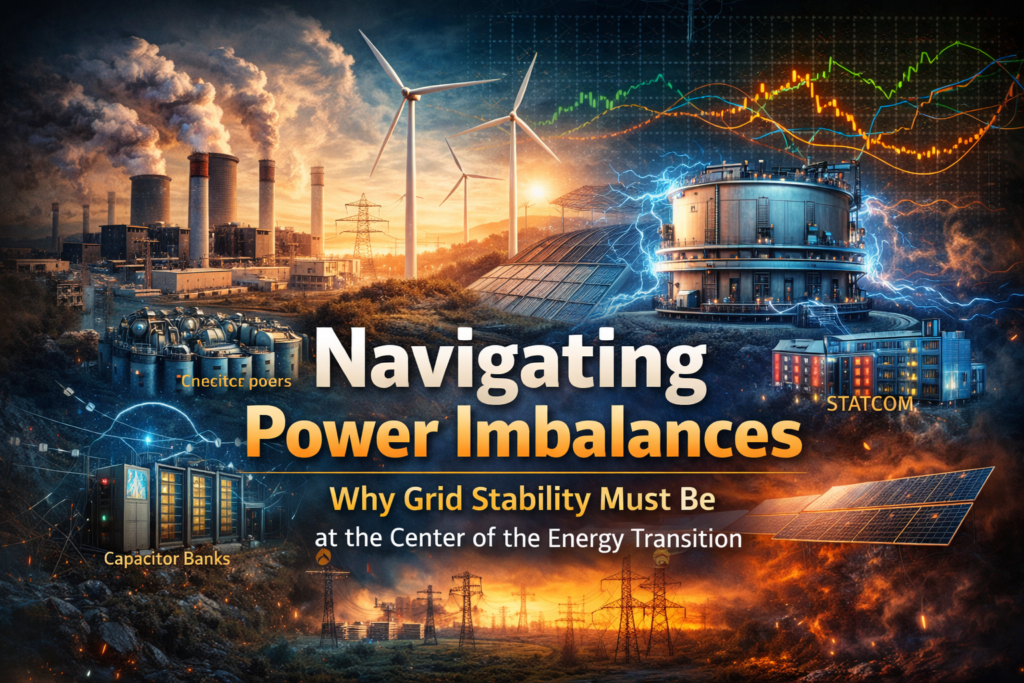
Why Grid Stability Must Be at the Center of the Energy Transition
Across the world, electricity systems are undergoing the most significant transformation since the creation of national grids. The rapid growth of renewable energy, combined with the expansion of long-distance electricity trading, is reshaping how power systems operate.
High-voltage direct current (HVDC) transmission has become essential for moving electricity across vast distances. Solar and wind generation are expanding rapidly. Microgrids are emerging. And modern networks increasingly rely on sophisticated power electronics to control the flow of energy.
But behind this technological progress lies a critical question:
Are we adequately protecting the stability of the grid itself?
Because stability is not optional. It is the invisible backbone that keeps lights on, industries running, and infrastructure functioning.
The Expanding Role of Power Electronics
Modern electricity networks rely heavily on power electronics.
Solar PV plants, battery storage systems, and HVDC transmission lines all use advanced electronic converters to regulate voltage, frequency, and energy flow. These devices allow flexible control of power and enable integration of renewable generation at unprecedented scales.
A particularly important technology now emerging is the Grid-Forming Converter (GFMC).
GFMCs are designed to help stabilize networks with high levels of inverter-based generation. As microgrids and distributed energy resources grow, these converters will increasingly influence system behaviour.
However, there is a trade-off.
While power electronics enhance flexibility and enable renewable integration, studies consistently show that widespread adoption can introduce power quality challenges, including:
- Voltage sags and swells
- Harmonic distortion
- Phase imbalance
- Reduced system inertia
These effects may appear subtle at first, but across a large, interconnected grid, they can accumulate into significant operational risks.
Understanding Power Quality Disturbances
Consider a typical three-phase system where voltages are ideally separated by 120 degrees.
Now imagine that one phase voltage drops by only 6%.
That small deviation can trigger harmonic disturbances:
- A 5% third harmonic component
- A 2% fifth harmonic component
These distortions propagate through the network, interacting with other power electronic devices and potentially amplifying instability.
What appears as a minor imbalance in one location can cascade across large sections of the grid.
Power systems do not fail because of a single catastrophic event.
They often fail because multiple small instabilities align.
The Risk of Retiring Rotating Generation Plants
While power electronics are increasing across networks, another critical trend is occurring simultaneously:
The retirement of conventional rotating generation plants.
Coal-fired, gas-fired, and steam turbine power stations have historically provided something extremely valuable to the grid:
Rotational inertia.
Large spinning generators act as stabilizing anchors within the system. Their physical mass resists sudden changes in frequency, providing the grid with critical time to respond to disturbances.
When these plants are removed without adequate replacements, the grid loses this stabilizing buffer.
The consequences may include:
- Faster frequency deviations
- Increased vulnerability to disturbances
- Higher risk of cascading outages
- Greater reliance on synthetic control systems
In other words, the grid becomes more fragile.
The transition to renewable energy must therefore consider not only how electricity is generated, but also how the grid remains stable while doing so.
Potential Solutions to Mitigate Power Quality Issues
Fortunately, engineers have several tools available to address emerging power quality and stability challenges.
Capacitors
Capacitor banks remain one of the simplest and most cost-effective methods of reactive power compensation. They help regulate voltage levels and support power factor correction.
However, they require physical space and have limited ability to absorb reactive power dynamically.
Static VAR Compensators (SVCs)
SVCs provide improved voltage regulation compared with traditional capacitor banks. They can dynamically adjust reactive power output and improve voltage stability across transmission networks.
Yet their response speed may not be sufficient to address rapid voltage fluctuations caused by modern inverter-based resources.
Static Synchronous Compensators (STATCOMs)
STATCOM systems represent a more advanced power electronics-based solution.
They provide:
- Fast voltage stabilization
- Dynamic reactive power support
- Improved grid flexibility
The drawback is cost. STATCOM installations are significantly more expensive than conventional compensation systems.
Synchronous Condensers
One of the most powerful — and often overlooked — solutions is the synchronous condenser.
Unlike electronic devices, synchronous condensers are rotating machines that directly contribute mechanical inertia to the grid.
Their benefits include:
- Frequency stabilization
- Reactive power support
- Voltage regulation
- Short-circuit strength improvement
Because they physically rotate, they help dampen disturbances in ways that power electronics alone cannot replicate.
Repurposing Coal-Fired Power Stations for Grid Stability
Rather than abandoning aging coal-fired power stations entirely, there is a compelling alternative:
Repurpose them as synchronous condensers.
Many coal plants already contain large generators perfectly suited for this role. By removing the steam turbines and replacing them with large-mass flywheels connected through Synchro-Self-Shifting (SSS) clutches, these generators can continue spinning and supporting grid stability.
This approach provides several advantages:
- Preserves valuable rotating inertia
- Utilizes existing infrastructure
- Eliminates carbon emissions from the plant
- Reduces capital investment compared with new installations
Instead of viewing old coal stations purely as liabilities, they could become strategic assets in stabilizing renewable-powered grids.
The Need for Strategic Planning in Grid Stability
Energy transitions cannot be managed through generation planning alone.
They require system-level stability planning.
Some grid operators have already recognized this reality.
In South Africa, Eskom has announced plans to install 11 synchronous condensers across its transmission network, including both newly constructed units and repurposed generators.
Internationally, similar initiatives are underway. The Australian Renewable Energy Agency (ARENA) has supported studies highlighting the importance of synchronous condensers in maintaining stability in high-renewable grids.
These initiatives demonstrate an important shift in thinking:
Grid stability must be engineered — it cannot be assumed.
From Risk to Resilience
As power systems evolve, instability risks will increase unless addressed proactively.
Power electronics, renewable energy, HVDC transmission, and distributed generation are all reshaping grid behaviour. Ignoring these structural changes would be a strategic mistake.
Engineers, utilities, regulators, and policymakers must therefore work together to:
- Monitor power quality more rigorously
- Preserve or replace grid inertia
- Integrate synchronous stabilizing technologies
- Plan transmission upgrades strategically
Failure to do so risks turning energy transitions into reliability crises.
International examples of synchronous condensers stabilizing renewable grids
1. Germany – Grid stabilization for the Energiewende
The German transmission operator TenneT has installed and commissioned synchronous condenser systems to maintain voltage stability and inertia as coal and nuclear plants retire and renewable penetration increases. Projects include installations at Großkrotzenburg and Würgassen substations.
2. Ireland – Moneypoint synchronous condenser project
The Irish transmission operator EirGrid installed a large synchronous condenser at the Moneypoint site as part of the Sustainable System Support facility, designed to provide large amounts of system inertia and short-circuit strength as wind penetration rises.
3. Ireland – Hybrid synchronous condenser + battery project
A second project combines a synchronous condenser with battery storage at Shannonbridge. The system provides large amounts of inertia while batteries provide fast dynamic support.
4. United Kingdom – National Grid stability programme
The British transmission operator National Grid ESO awarded contracts for six synchronous condensers in Scotland and England as part of its Stability Pathfinder programme to support a low-carbon grid.
5. South Australia – Supporting one of the world’s highest renewable grids
The transmission operator ElectraNet installed multiple synchronous condensers in South Australia to maintain system strength after coal plant closures and rapid growth of wind and solar.
6. Texas – ERCOT grid strength initiatives
In Texas, grid operator ERCOT has supported synchronous condenser installations to improve short-circuit strength and voltage stability in regions with high wind generation.
A Final Reflection
Electricity systems are among the most complex machines humanity has ever built.
Every technological shift — from rotating machines to inverter-dominated networks — alters how these systems behave.
The challenge now is not simply to generate cleaner electricity.
The challenge is to ensure that the grid remains stable, resilient, and controllable in the process.
Because without stability, even the cleanest energy system cannot keep the lights on.
Power Quality Consulting Solutions