
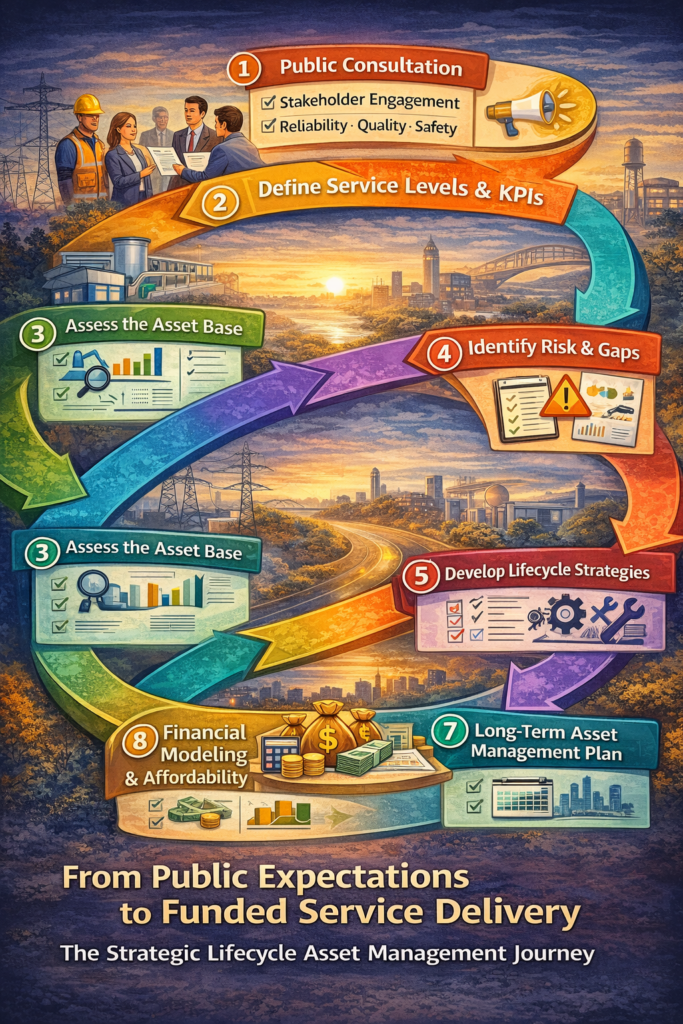
The Strategic Lifecycle Asset Management Journey
Infrastructure does not exist for its own sake. Electricity networks, water systems, transportation corridors, and treatment facilities exist to serve people.
Yet too often, asset management is viewed as a technical or financial discipline disconnected from community value.
Mature asset management begins with the public — and ends with funded service delivery. Between those two points lies a structured, strategic lifecycle process that ensures infrastructure performs reliably, sustainably, and affordably over the long term.
This article outlines that journey.
1. Listening First: Public Consultation & Stakeholder Engagement
Strategic asset management begins with a simple principle:
Define value before defining assets.
Utilities engage customers, regulators, government bodies, commercial users, and community representatives to understand what truly matters.
Common expectations include:
- Reliable electricity supply
- Safe and compliant drinking water
- Smooth and safe road networks
- Rapid response to service disruptions
- Fair and predictable tariffs
- Environmentally responsible operations
This consultation phase establishes the organization’s value framework. Without it, technical plans risk misalignment with customer priorities.
2. Translating Expectations into Service Levels & KPIs
Public expectations must be converted into measurable commitments.
Utilities define:
Service Level Statements
Clear performance commitments such as:
- Maximum outage duration
- Water quality compliance rates
- Minimum pavement condition scores
- Emergency response time thresholds
Key Performance Indicators (KPIs)
Quantifiable measures that allow monitoring and accountability, including:
- Reliability indices
- Asset condition ratings
- Preventive maintenance compliance
- Safety performance metrics
KPIs become the measurable expression of the utility’s promise to its customers.
3. Assessing the Asset Base
With performance targets defined, the next question becomes:
Can our current assets deliver these commitments?
A structured portfolio assessment evaluates:
- Asset inventory accuracy
- Physical condition
- Remaining useful life
- Criticality and consequence of failure
- Capacity constraints
- Historical performance trends
This stage provides clarity on whether the existing infrastructure is capable — or whether intervention is required.
4. Identifying Risk & Performance Gaps
Where gaps exist between current performance and required service levels, risk analysis is applied.
This includes assessing:
- Likelihood of asset failure
- Safety consequences
- Environmental impact
- Regulatory exposure
- Customer disruption
Risk-informed prioritization ensures that resources are directed toward the most critical vulnerabilities rather than reacting to failures after they occur.
5. Developing Lifecycle Strategies
With risks and performance gaps identified, utilities design lifecycle strategies for each major asset class.
These strategies determine:
- Preventive and predictive maintenance regimes
- Optimal renewal timing
- Upgrade or expansion needs
- Decommissioning plans
The objective is to optimize total cost of ownership while maintaining service performance.
Lifecycle strategy is where engineering judgment, data analytics, and financial awareness converge.
6. Building the Long-Term Asset Management Plan
Lifecycle strategies are consolidated into a structured long-term roadmap — often covering 10 to 30 years.
The Asset Management Plan typically includes:
- Capital renewal forecasts
- Maintenance programs
- Risk mitigation initiatives
- Performance improvement targets
- Capacity expansion plans
This document becomes the organization’s strategic blueprint for sustaining service delivery over decades.
7. Testing Affordability Through Financial Modeling
Even the best technical plan must be financially sustainable.
Utilities conduct long-term modeling to evaluate:
- Revenue adequacy
- Tariff impacts
- Debt capacity
- Sensitivity to regulatory or demand changes
This stage may require balancing ambition with affordability. In some cases, service levels are adjusted, renewal timing is optimized, or risk tolerance is refined.
It is an iterative process — aligning engineering strategy with financial reality.
8. Converting Strategy into Budgeted Action
The final step transforms long-term plans into actionable budgets.
Capital Budgets (CapEx)
Funding for:
- Major renewals
- New infrastructure
- System upgrades
- Capacity expansion
Operating Budgets (OpEx)
Funding for:
- Maintenance programs
- Inspections
- Staffing
- Minor repairs
- Operational costs
Every allocation should trace directly back to:
- A defined KPI
- A risk priority
- A lifecycle strategy
When budgets are built this way, spending becomes strategic — not reactive.
The Strategic Lifecycle in One Flow
The process can be summarized as:
- Public Expectations
- Service Level Commitments
- KPI Definition
- Asset Capability Assessment
- Risk & Gap Analysis
- Lifecycle Strategy Development
- Long-Term Financial Modeling
- Budget Allocation for Service Delivery
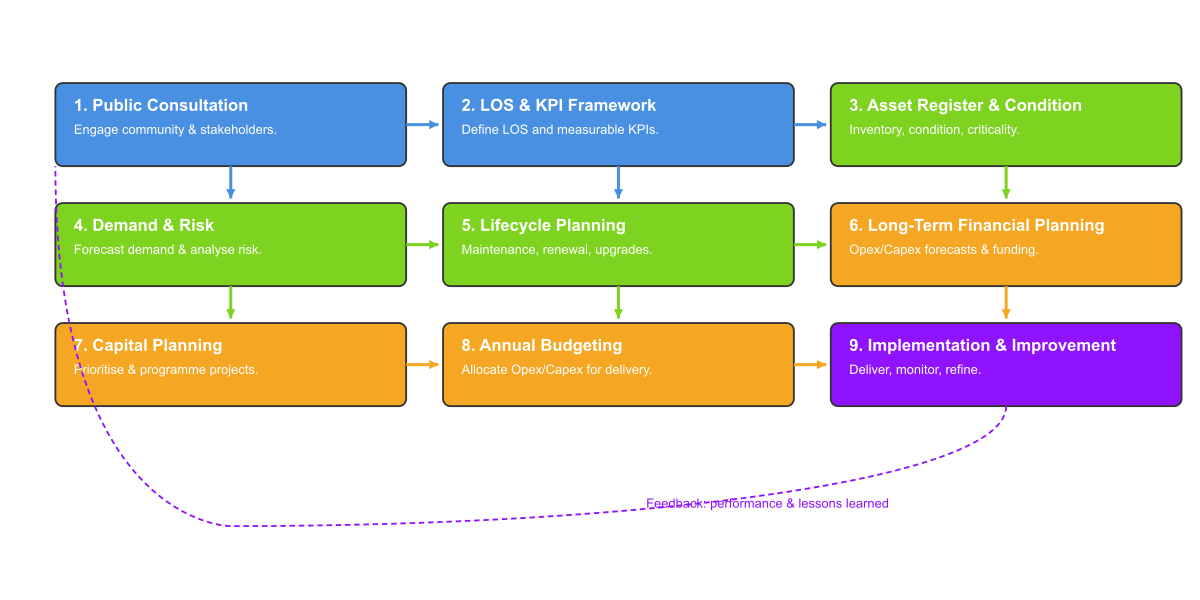
Each stage builds logically on the previous one, forming a disciplined governance framework.
Why This Approach Matters
Strategic lifecycle asset management ensures:
- Service reliability
- Risk resilience
- Financial sustainability
- Transparent decision-making
- Strong governance
- Long-term customer trust
Most importantly, it ensures that infrastructure investment is not driven by short-term pressures but by clearly defined public value.
When done properly, money spent can be traced back to a customer expectation and a measurable service commitment.
That is the hallmark of a mature utility organization.
Enterprise Asset Management Consulting