
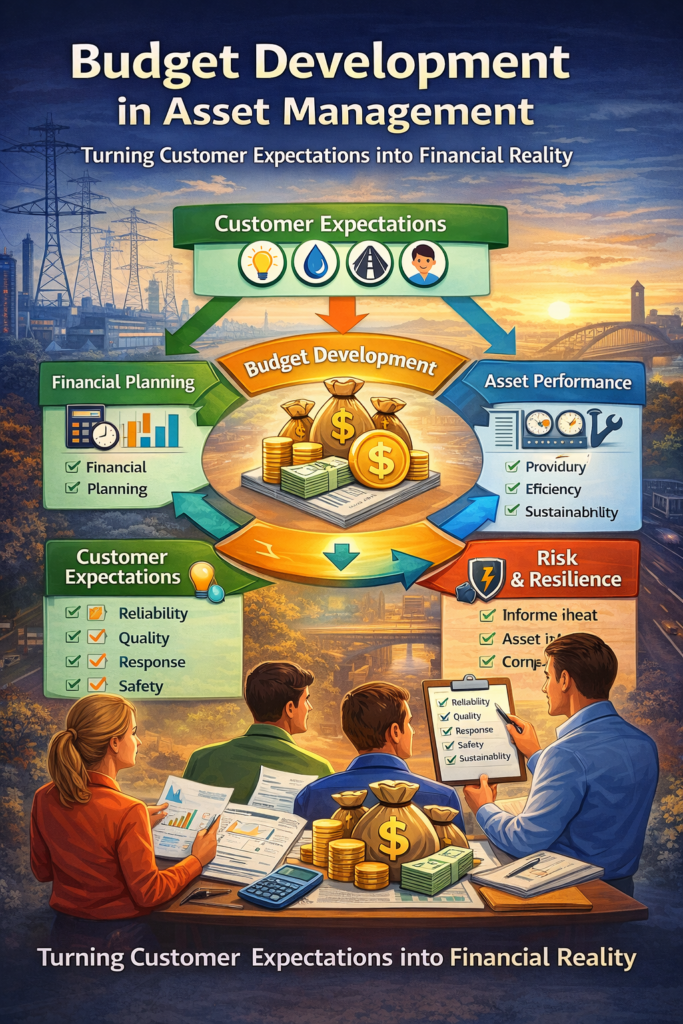
Turning Customer Expectations into Financial Reality
In our previous article, we established that customer expectations are the foundation of effective asset management. Utilities exist to deliver reliable electricity, safe drinking water, dependable transportation networks, and other essential services. Those expectations shape performance targets — and those targets must ultimately be funded.
This is where Budget Development becomes critical.
Budget development is not simply a financial exercise. It is the structured process through which a utility organization translates service commitments into sustainable financial plans. When done correctly, it connects customer value, asset performance, risk management, and long-term financial health into one coherent strategy.
Let’s explore the key elements.
1. Aligning Budgets with Service Level Commitments
Every financial plan should begin with a simple question:
What level of service have we committed to delivering?
Utilities often define measurable service standards such as:
- Target outage duration (electricity)
- Water quality compliance levels
- Road or network condition ratings
- Response times to customer faults
- Infrastructure reliability thresholds
Budget development must ensure adequate funding to maintain or improve these standards. If funding falls short, service levels decline — and customer trust erodes.
Strong utilities make this alignment explicit:
- Service targets → Asset interventions → Required funding → Approved budget
This transparency strengthens both governance and accountability.
2. Lifecycle-Based Financial Planning
Assets consume resources across their entire lifecycle — not just during construction.
Effective utilities budget across:
- Planning and design
- Construction or acquisition
- Operations
- Maintenance
- Renewal or rehabilitation
- Disposal or decommissioning
Too often, organizations underfund maintenance to prioritize new capital projects. While this may deliver short-term visibility, it increases long-term risk and lifecycle cost.
A mature budget development process applies lifecycle costing principles, ensuring that total cost of ownership is understood and funded appropriately. This approach stabilizes performance and prevents deferred maintenance backlogs.
3. Capital vs. Operating Balance
Utilities must balance two interconnected financial streams:
Capital Expenditure (CapEx)
Investment in new assets, major renewals, and upgrades.
Operating Expenditure (OpEx)
Day-to-day maintenance, staffing, inspections, and minor repairs.
Over-investing in capital while neglecting operating budgets can create assets that cannot be properly maintained. Conversely, excessive operational spending without strategic capital renewal leads to aging infrastructure and rising failure rates.
Strategic budget development optimizes the CapEx–OpEx balance to deliver sustained service reliability.
4. Risk-Informed Investment Decisions
Not all assets carry equal risk.
A transmission substation, water treatment facility, or major bridge failure has far greater consequences than a minor local asset. Budget development must prioritize investments based on:
- Probability of failure
- Consequence of failure
- Safety implications
- Regulatory exposure
- Environmental impact
- Customer disruption
Risk-based budgeting ensures that limited financial resources are directed where they protect the most value.
This moves utilities away from reactive spending toward proactive resilience planning.
5. Affordability and Financial Sustainability
Utilities operate within financial constraints:
- Revenue limitations
- Tariff regulations
- Grant availability
- Borrowing capacity
- Customer affordability thresholds
Budget development must balance service ambition with economic reality.
This requires long-term financial modeling, including:
- Multi-year capital forecasts
- Asset renewal curves
- Debt servicing capacity
- Sensitivity analysis for risk events
Sustainable utilities avoid dramatic tariff shocks or emergency borrowing by planning well ahead of asset deterioration peaks.
6. Transparency and Governance
A robust budget development process improves governance by making trade-offs visible.
When funding is insufficient, leadership must decide:
- Reduce service levels?
- Accept higher risk?
- Increase tariffs?
- Defer projects?
Documenting these trade-offs creates organizational clarity and strengthens board-level oversight.
Well-developed budgets are not just financial documents — they are strategic declarations of intent.
Budget Development as a Strategic Bridge
In the Customer-Driven KPI Map, budget development serves as the bridge between:
Customer Expectations → Asset Performance → Financial Reality
It converts promises into funded programs.
Without disciplined budget development:
- Service levels drift
- Maintenance is deferred
- Risk accumulates
- Financial instability grows
With disciplined budget development:
- Service commitments remain achievable
- Asset health stabilizes
- Risk is managed proactively
- Utilities remain resilient and trusted
Looking Ahead
In the next part of this series, we will examine how approved budgets translate into Operational Planning and Performance Execution — ensuring that financial commitments are converted into measurable service outcomes.
Because in asset management, strategy only creates value when execution follows.
Enterprise Asset Management Consulting