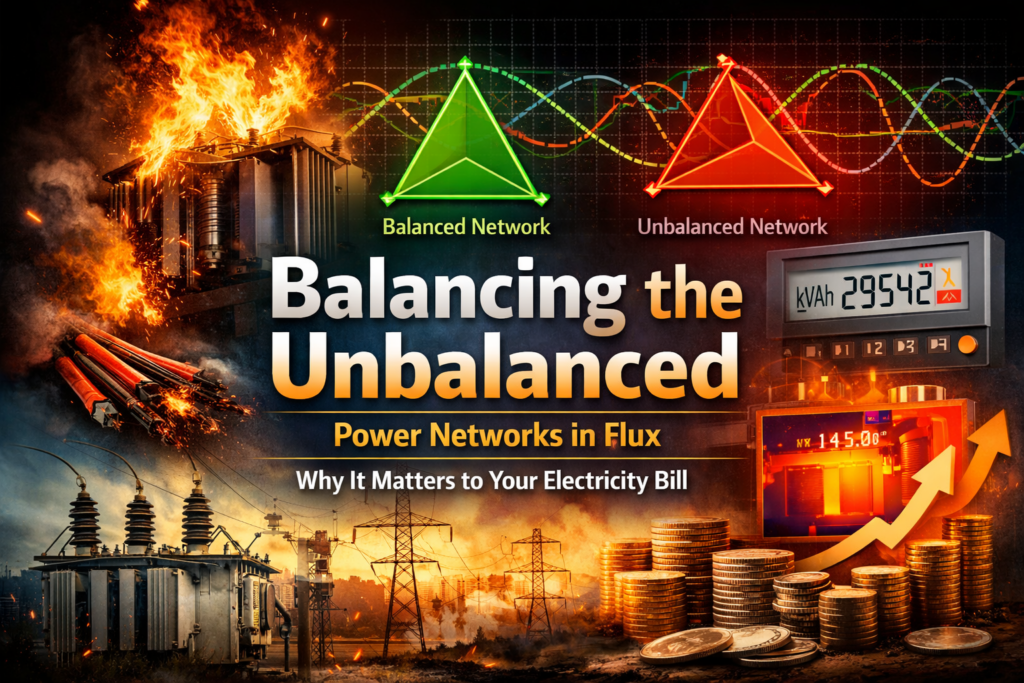
Power Networks in Flux — And Why It Matters to Your Electricity Bill
When transformers fail, cables burn off, or substations experience catastrophic damage, the explanation often defaults to a vague conclusion:
“Equipment failure.”
“Overload.”
“Unknown cause.”
Yet it increasingly appears as if some engineers and consultants still struggle to accept a fundamental reality: transformers do not simply “go up in flames” without physics being involved.
In my previous article, “When Transformers Go Up in Flames — Are We Asking the Right Questions?” I raised a critical issue: before attributing transformer failures to coincidence, age, or overload, are we rigorously examining voltage imbalance, negative-sequence currents, and zero-sequence components?
Transformers do not combust spontaneously.
Cables do not overheat without cause.
Heat is generated because electrical conditions demand it.
This article builds on that argument using measured power quality data from the Ekurhuleni Metropolitan Area and the Johannesburg Metropolitan Area. The findings point to measurable unbalanced network conditions that:
- Increase system losses
- Generate excessive heat
- Stress infrastructure
- Inflate consumer electricity bills
Physics is not optional.
And imbalance is not harmless.
What a Perfectly Balanced Network Looks Like
In an ideal three-phase system:
- All voltage magnitudes are equal
- Each phase is displaced by exactly 120°
- Only a positive-sequence component exists
- There are no negative- or zero-sequence components
Under these conditions:
- Neutral currents are minimal
- Transformer losses are controlled
- Motors operate efficiently
- Apparent power closely tracks real power
That is what system design textbooks assume.
Real-world radial networks, however, often tell a different story.
Recorded Conditions in the Ekurhuleni Metropolitan Area
Extended monitoring on a municipal feeder within the Ekurhuleni Metropolitan Area revealed:
- Significant negative-sequence voltage magnitudes
- Clearly measurable zero-sequence components
- Noticeable phase displacement irregularities
- Distorted phase-to-phase voltage geometry
In the video “Substation in Ekurhuleni Metropolitan Area”
the visual comparison is unmistakable:
- The green triangle represents an ideally balanced network.
- The red triangle represents the actual recorded phase-to-phase voltages.
In a balanced system, the triangle is symmetrical and centered.
In the recorded data, the red triangle is distorted and displaced.
Now imagine that these are the voltages being supplied on the 6.6 kV feeders to municipal-owned mini-substations and consumer transformers.
Imagine the circulating currents created in transformer delta windings.
Imagine the neutral currents.
Imagine the cumulative heat generated by these distorted voltages — the red triangle.
Heat is not theoretical.
It is the inevitable outcome of imbalance.
Recorded Conditions in the Johannesburg Metropolitan Area
Short-term monitoring within the Johannesburg Metropolitan Area revealed similarly concerning conditions.
At a specific recorded moment:
- Two phase-to-neutral voltages were nearly identical in magnitude and displacement
- The phase-to-phase voltage between two phases measured near zero
- The positive-sequence component was rotated and reduced
- Negative- and zero-sequence components were clearly present
The results are illustrated in the video:
“Residential Property in Johannesburg Metropolitan Area”
Again:
- The green triangle represents a balanced network.
- The “red triangle” represents the actual recorded phase-to-phase voltages.
But here is the critical distinction:
These are not upstream feeder voltages.
These are the voltages coming directly out of the distribution transformer in the area.
In other words, this is what is being delivered to properties.
It is therefore no wonder that several transformers in the area have already gone up in flames.
Transformers subjected to persistent negative-sequence and zero-sequence conditions generate excessive heat internally. Over time, insulation degrades, windings stress, and failure becomes a matter of when — not if.
Why This Directly Impacts Your Electricity Bill
In AC systems, three power components define energy flow:
- Real Power (kW) — performs actual work
- Reactive Power (kVAR) — sustains magnetic and electric fields
- Apparent Power (kVA) — vector sum of real and reactive power
Many consumers assume they are billed purely for kWh.
In reality, numerous metering systems — particularly prepaid configurations — effectively register kVAh.
Unbalanced network conditions increase apparent power, even if real power consumption remains unchanged.
Consumers cannot control:
- Voltage imbalance
- Negative-sequence voltages
- Zero-sequence components
Yet they pay for the increased apparent energy that results from these inefficiencies.
Comparative Load Analysis
Near-Balanced Network Condition
(Ekurhuleni Metropolitan Area Data)
- Maximum Apparent Power: 59.554 kVA
- Maximum Real Power: 57.160 kW
- Ratio S:P = 1.04 : 1
- Power triangle angle: 16.30°
Efficient. Stable. Predictable.
Unbalanced Network Condition
(Johannesburg Metropolitan Area Data)
- Maximum Apparent Power: 3.666 kVA
- Maximum Real Power: 1.549 kW
- Ratio S:P = 2.37 : 1
- Power triangle angle: 65.01°
Apparent power was nearly 2.4 times the real power required.
The load did not justify this disparity.
The network condition did.
The Financial Consequence
When normalized against balanced conditions:
- The expected cost under a stable network would be substantially lower
- The difference represents payment for upstream inefficiencies
In the comparison performed, the difference exceeded 100%.
Consumers may therefore be paying dramatically more — not because they are consuming more real power, but because they are supplied with an unbalanced network.
Infrastructure Consequences
Unbalanced networks cause:
- Elevated neutral currents
- Transformer overheating
- Circulating delta winding currents
- Accelerated insulation ageing
- Increased failure rates
- Unexpected outages
Failures are often described as isolated events.
Yet when symmetrical component analysis is applied, patterns emerge.
Final Thoughts
Transformers do not go up in flames without physics being involved.
Unbalanced network conditions are:
- Measurable
- Quantifiable
- Technically significant
- Financially consequential
They generate heat.
They inflate apparent power.
They stress infrastructure.
They increase bills.
The real question is no longer whether imbalance exists.
The data shows that it does.
The question is:
Are utilities systematically monitoring and correcting these imbalances — or are consumers and infrastructure simply absorbing the cost of ignoring them?
Power Quality Consulting Solutions