
Best Practices, Physical Asset Management
Where Does the Asset Management Process Begin and End?
Mar
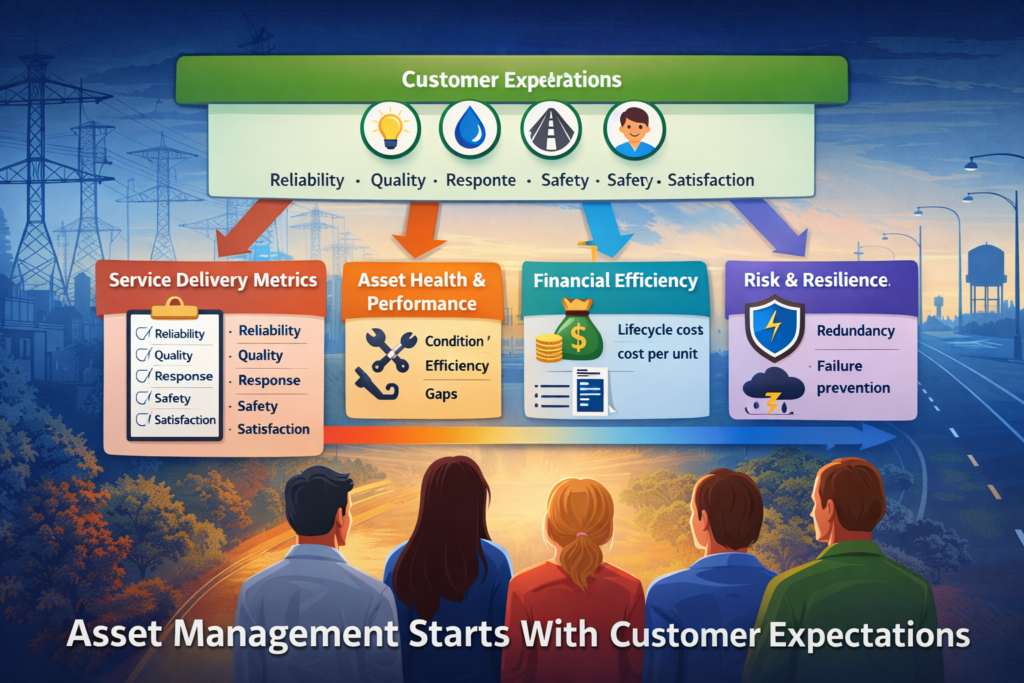
The asset management process for organizations providing essential public services—such as electricity generation and distribution, water supply, roads, and railways—begins with a simple principle: these organizations exist because the public cannot provide these services themselves. Consequently, they are accountable to the communities they serve.
At the heart of this accountability lies the most fundamental starting point of asset management: understanding what customers expect. These expectations form the foundation for every subsequent decision in managing assets effectively.
1. Translating Expectations into Measurable Service Delivery
Customer expectations are often broad and qualitative: they want reliable electricity, clean water, safe roads, and uninterrupted service. To manage these effectively, organizations must translate these expectations into quantifiable service delivery metrics. For example:
- Reliability metrics (e.g., uptime, frequency of outages)
- Quality metrics (e.g., water purity levels, road smoothness, voltage stability)
- Response metrics (e.g., speed of fault resolution, service restoration)
- Safety metrics (e.g., incidents reported, risk mitigation measures)
- Satisfaction metrics (e.g., survey scores, complaint volumes)
By establishing clear, measurable indicators, organizations can objectively monitor whether they are meeting customer expectations.
2. Assessing Asset Health and Performance
Once service delivery metrics are defined, the next step is to evaluate the health and performance of the assets themselves. This involves:
- Conducting physical condition assessments of all assets
- Identifying performance gaps and potential failures
- Evaluating the efficiency and utilization of assets
- Determining maintenance, refurbishment, replacement, or disposal requirements
These evaluations ensure that assets can deliver the services customers expect.
3. Monitoring Financial Efficiency for Sustainable Service Delivery
A sustainable asset management program must also include financial performance metrics. This step ensures that the organization can maintain service delivery over the long term without overspending or underfunding critical infrastructure. Key considerations include:
- Lifecycle costs of assets
- Maintenance and repair expenditures
- Cost per unit of service delivery
- Efficiency of resource allocation
By linking financial oversight to asset performance, organizations can ensure that investments are both strategic and sustainable.
4. Integrating Risk and Resilience
Although often presented as a later step, risk and resilience management is a foundational component that should be considered from the outset. By assessing vulnerabilities, anticipating failures, and planning for contingencies, organizations can safeguard service continuity and protect public trust. This includes:
- Evaluating the likelihood and impact of asset failures
- Ensuring redundancy and backup capacity
- Aligning risk management with maintenance and investment plans
In summary, the entire asset management process begins with customers. Understanding their expectations drives measurable service metrics, informs asset performance assessments, guides financial planning, and shapes risk and resilience strategies. This customer-first approach ensures that the organization delivers services efficiently, sustainably, and reliably.
Importantly, while this establishes the framework for performance and planning, it also sets the stage for budgeting, which ultimately determines how tariffs are set and resources are allocated — a critical topic that will be addressed in the next segment of this series.
Enterprise Asset Management Consulting